

areas of knowledge - human science
Scope of Human Science
What does human science claim to know - and where does that claim stop?
This is Knowledge and the Knower Part 2
THE PROVOCATION
Go back to Core Lesson 1. When the course first asked who the knower is, it turned to human science: Gardner on why no single genius invents anything alone, Vygotsky on how understanding grows out of talking to other people, Fricker on whose word gets believed, Steven Johnson on the gap between who you think you are and how you actually behave. None of them was a physicist or a mathematician. Look across the Core Lessons as a whole and the pattern holds: most of the thinkers this course keeps returning to are human scientists.
Human science studies people, and the people doing the studying are people too. An atom does not mind being measured by a physicist. A triangle does not resent being proved by a mathematician. Three hundred years on, a battle has no opinion about being reinterpreted by a historian. Human science does, because the knower and the known are the same kind of thing.
I suspect more TOK teachers have a background in human science than in any other discipline. I say suspect, not know. But if TOK itself were an Area of Knowledge, it would probably feel most at home here.
Big idea 1 - Human science is not one thing.
Ask what "human science" actually covers and the range is wide. A psychologist running a controlled experiment on memory, an anthropologist spending a year inside a community to map a kinship system, an economist modelling how prices respond to a shock, a political scientist comparing constitutions across forty countries: these are different activities, using different tools, answerable to different standards of evidence.

The disciplines mapped above, psychology, cognitive science and psychiatry studying the individual mind; sociology, anthropology and demography studying groups and culture; economics, political science and human geography studying the systems people build, are held together by their object rather than their method: a subject capable of knowing it is being watched, and of changing because of it. A rock does not behave differently because a geologist is watching it. A person, a market, or a community sometimes does.
That is also why the boundaries between these disciplines are so porous. Behavioural economics exists because classical models assumed people calculate costs and benefits rationally, until experiments showed people will reject a fair cash offer simply because it feels unfair, a result economics alone could not explain. Social psychology exists because Solomon Asch showed that people will give an answer they can see is wrong, out loud, rather than contradict a room full of strangers, a result psychology alone could not have produced without a group to conform to (see Human science ethics). Political sociology exists because how people vote often tracks their community and social identity more reliably than it tracks the policies they say they believe in. Each of these hybrid fields, and the others on the map, exist because the same reflexive subject keeps forcing neighbouring disciplines to borrow from each other.

Big idea 2 - Two founders, two methods.
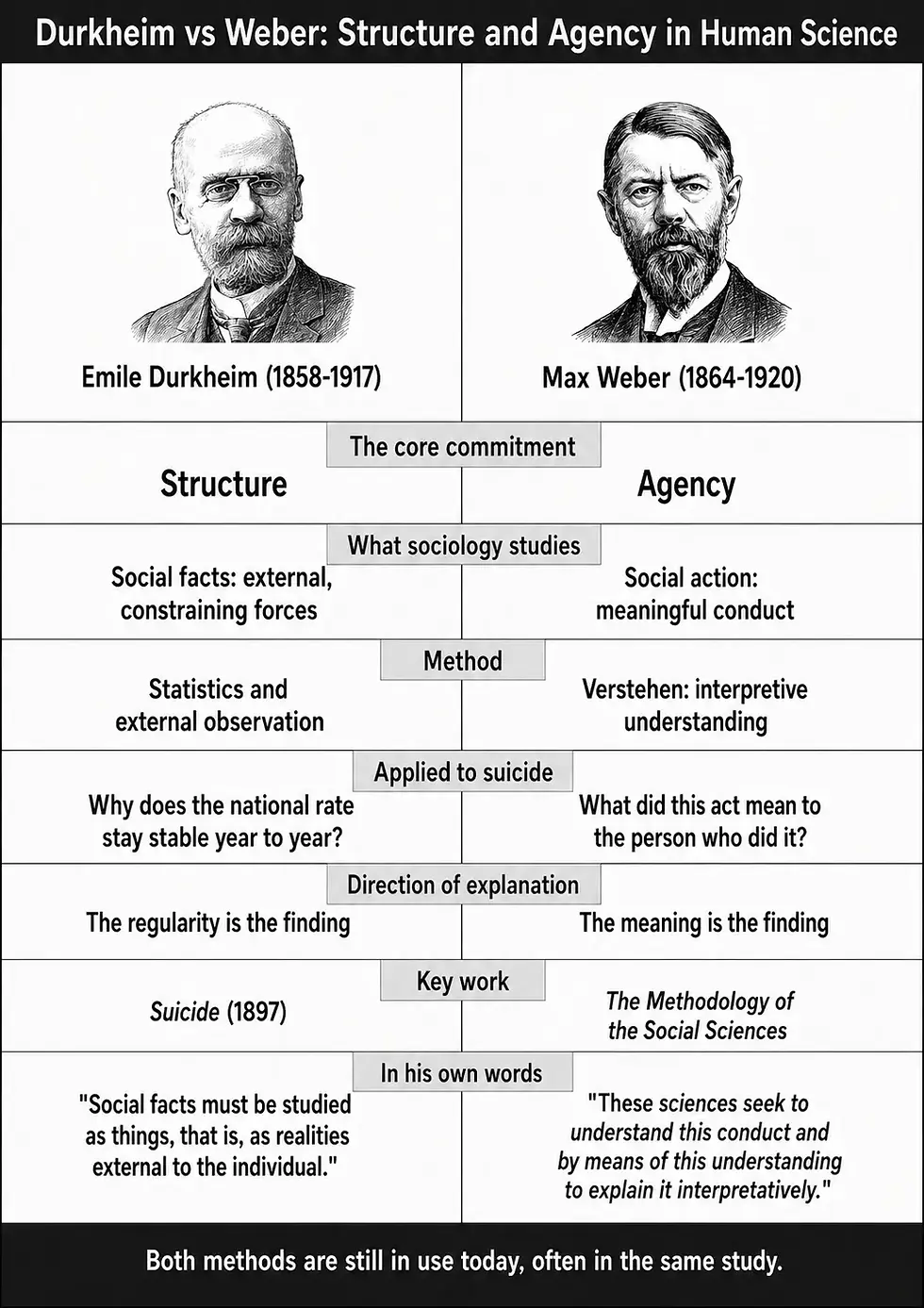
In 1897 Emile Durkheim asked why a country's suicide rate holds remarkably steady from year to year, even though each suicide is the product of a private, unrepeatable crisis. His answer became one of sociology's founding claims: "social facts must be studied as things, that is, as realities external to the individual." For Durkheim, the national suicide rate was itself a fact, as real and measurable as anything in the natural sciences, independent of any single person's motives. He studied it the way natural science studies anything else, through statistics and external observation. This is the structure side of the argument: social forces shape what a person does, whether or not that person notices the shaping.
Max Weber, writing in the same period, argued that this leaves out the part that makes human conduct human. A rock falls; it means nothing by falling. A person voting or resigning from a job is doing something meaningful, and Weber argued that a sociologist must grasp that meaning from the actor's own point of view. He put it this way: "these sciences seek to understand this conduct and by means of this understanding to explain it interpretatively." He called this method verstehen. This is the agency side of the same argument: whatever the social forces at work, the individual is still the one who decides and means something by acting.
Both methods are still in use, often in the same study, and neither has settled which one explains more. Both also run into the same problem. In natural science, a law is usually where an explanation ends: Newton's laws applied to a falling apple close the question of why it fell. In human science, a law is often where the explanation starts. The law of demand states that as price rises, quantity demanded falls. That regularity still has to be explained, by reasoning or incentive, before anyone understands why it holds. Durkheim's stable suicide rate works the same way: the number is where the inquiry begins, not where it ends.
Big idea 3 - The world you didn't know you built
Most of what you take for granted, you did not choose: the school day split into fixed periods, what counts as a normal family. None of it existed before someone else decided it. In 1966 Peter Berger and Thomas Luckmann described how this happens, and they said openly where the idea came from: their own introduction credits a dialectical perspective derived from Marx, alongside Durkheim's account of social reality and Weber's emphasis on subjective meaning. A habit repeated by enough people becomes a shared expectation. A shared expectation, handed to children who never chose it, becomes an institution. By the time you are born into it, the institution feels as fixed as the weather. Berger and Luckmann summarised the whole process in three sentences: "Society is a human product. Society is an objective reality. Man is a social product."
That middle sentence is the trap, and it is the one you are living inside right now. Something made entirely by people can come to feel like a fact of nature, and once it does, the people living with it stop noticing they made it. Berger and Luckmann called this reification: "the apprehension of human phenomena as if they were things, that is, in non-human or possibly suprahuman terms." The idea is older than their book. In 1844, in an unpublished manuscript, Marx described how the object that labour produces "confronts it as an alien being, as a power independent of the producer," solidifying, in his words, into "a thing." Reification is that same reversal, generalised from a factory floor to any institution you didn't build yourself.
You are one of those people. Every assumption you hold about what a good student looks like or what ambition should feel like was built into you the same way, by people who built it into themselves first. This is where the structure and agency problem stops being abstract. A physicist studying an atom is not made of the same material she is studying. A sociologist studying socialization was herself socialized, by the same kind of process she is now trying to describe from the outside. Human science cannot borrow natural science's certainty here, because there is no outside to stand on. The knower was built by the same forces as the thing being known.
This course carries the same problem inside it. You are sitting these exams because, at some point, it was decided that a set of grades earned at seventeen or eighteen would open or close certain doors: this university or that career. None of that was inevitable, and a different society could easily have sorted people out some other way. It is also entirely real: it will affect what you can study and where you can work.
There is a second layer to this, though, that goes further than the grades themselves. Whoever does well on these exams will be tempted to believe the outcome reflects something true about their own effort and worth, and forget how much of it also came down to which subjects happened to suit them or which school they attended. Michael Sandel traces this belief back to the same logic Weber described a century earlier: the fortunate are rarely satisfied with the fact of being fortunate, they also need to believe they have a right to it. That belief is built the same way a suicide rate or a school timetable is built, and it is just as capable of being mistaken for a fact about you rather than a story your society tells about success.
Whether the last two years have mainly been about Quomodo Scimus, how we know, or about the extra points that get you into a good university and a well paid profession, is not a question this course can settle for you. It is the same question this Big Idea has just asked about the school day and what counts as a normal family, aimed now at the exam you are sitting, and at whatever you end up believing about why you did the way you did.
The scope of Human Science compared
The knower cannot step outside what's being known
In Mathematics, the knower barely matters. A proof holds regardless of who wrote it or who reads it, which is part of what makes mathematical objects feel like they exist independently of any mind at all. In Natural Science, funding and institutions can shape which experiments get run, but the knower remains a separate kind of thing from the atom or the bacterium under study. In History, the object of study, the past itself, no longer exists at all; historians work from what survives of it, at one remove from the events themselves.
In Human Science, the knower is made of the same material as the object of study, all the way down. A sociologist studying conformity is herself capable of conforming. A person studying how institutions get taken for granted was themselves raised inside institutions they took for granted.
This is why Durkheim and Weber split over method in the first place, and why Berger and Luckmann's reification is a genuinely different kind of problem from anything Mathematics, Natural Science, or History has to answer. A mathematician does not need to worry that the number seven was socially constructed. A historian can accept that the archive is incomplete without worrying that the historian herself is also, in part, the archive. Human science cannot make either of those moves. Whatever it discovers about how people come to believe what they believe, it has to admit applies to the discovering as well.
The Arts share Human Science’s difficulty in a different form. Scope of the Arts treats the maker’s own perspective as part of the work rather than something to be filtered out. Human Science tries to correct for the fact that the knower and the known are made of the same material. The Arts mostly do not try. A painting does not pretend the painter’s hand was absent from it.
Think further: questions and resources
-
Solomon Asch found that about a third of people conformed to an obviously wrong answer on a simple test at least once. If that many people bend to group pressure on something as easy to check as the length of a line, how much of what you believe about harder questions, your own abilities, what's fair, what's normal, has ever actually been tested against your own judgment at all?
-
Durkheim treated the suicide rate as a fact you could study like any object in nature; Weber insisted you have to reconstruct the meaning behind an action from the inside. Can one method ever capture both what a society does in aggregate and what a person meant by doing it, or does human science have to keep switching between the two depending on the question?
-
Berger and Luckmann argue that an institution you were born into, a school system, a family structure, a border, can feel as fixed as the weather even though people built it. If you accept that something is humanly constructed rather than natural, does that change how you should treat it, or only how you feel about it?
-
Human science splits into at least nine overlapping disciplines, psychology and sociology, anthropology and economics among them, with several hybrid fields bridging the gaps between them. If a single question, like why people vote the way they do, needs three of these disciplines at once, what is actually gained by keeping them separate rather than treating human science as one unified field?
-
In 2010 the American Anthropological Association dropped the word "science" from its mission statement, and members argued for years afterward about whether that was accurate or a mistake. If a field's own practitioners cannot agree whether it is a science, what, if anything, hangs on the answer?
-
This page has argued that you cannot fully step outside what you are studying in human science, because you were built by the same forces you are now trying to describe. Does that mean a human scientist, or a student taking this course, can never really know their own society objectively, or is partial, situated knowledge still knowledge?
Films
For more see my 10 films for the TOK journey page.
🎬 WATCH — The Truman Show (1998)
Peter Weir
Truman Burbank has lived his entire life inside a manufactured town, built and cast by a television network, without knowing it. Everyone around him, his wife and his neighbours, is an actor playing a role in a world constructed specifically to feel natural to him. The film is a fairly literal picture of what Berger and Luckmann call reification: an entirely human-made world that a person experiences as simply how things are, until small inconsistencies start to show through the seams. My students can see the film here.
🎬 WATCH — Parasite (2019)
Two families, one wealthy and one struggling, become entangled through a series of small deceptions. The wealthy family's comfort and the poor family's desperation are both shaped by structures neither chose, housing and employment among them, that sort people before they've had any real chance to choose for themselves. But the plot only moves because of what individual people decide to do inside those constraints. The film sits exactly on the line between Durkheim's structure and Weber's agency: it never lets you explain what happens by appeal to class alone, and never lets you ignore class either. My students can see the film here.
🎬 WATCH — The Wave / Die Welle (2008)
Dennis Gansel
A German teacher runs a week-long classroom experiment to show his students how fascism could take hold, dividing them into a movement with a name, a salute, and a uniform. By day three the students are policing each other's loyalty; by day five the game has stopped being a game. The film compresses Asch's finding, that roughly a third of people will go along with an obviously wrong answer, into something closer to real time: a habit repeated for a few days becomes an institution, complete with its own outsiders and enforcers, before anyone involved fully notices what they built. My students can watch the film in German here.
Further reading
📚 READ - Suicide: A Study in Sociology, Émile Durkheim, 1897
This page quotes Durkheim's methodological principle, that social facts must be studied as things, but not how he actually puts it to work. Book Two, Chapter 1, "How to Determine Social Causes and Social Types," is where he moves from the principle to the practice, showing what it actually looks like to treat a suicide rate as data rather than as a collection of private stories. Reading this chapter alongside the page's quote shows the method in action, not just stated. In the library in TOK Books > Human science.
📚 READ - The Methodology of the Social Sciences, Max Weber
The page quotes Weber's essay "The Meaning of 'Ethical Neutrality'" on understanding and interpretation. His second essay in this collection, "'Objectivity' in Social Science and Social Policy," introduces a different tool entirely: the ideal type, a deliberately one-sided concept, like "the medieval city economy," built to make sense of reality without claiming to describe any single case exactly. Read from around p. 89, where Weber defines the ideal type directly. It's the clearest account of how a sociologist can generalise about people without pretending those generalisations are simply facts. In the library in TOK Books > Human science.
📚 READ - The Social Construction of Reality, Peter Berger and Thomas Luckmann, 1966
This page uses Berger and Luckmann's account of how institutions get built and then forgotten. Part III of the book, "Internalization of Reality," starting p. 149, covers the half of the story this page doesn't: how a specific person, you, for instance, actually absorbs a ready-made social world during childhood and comes to experience it as simply the way things are. Read this alongside BI3 for the mechanism behind the claim. In the library in TOK Books > Human science.
📚 READ - Karl Marx: Selected Writings, ed. David McLellan, 2000
The page quotes Marx's early writing on alienated labour. His 1859 Preface to A Critique of Political Economy, on p. 425 of this edition, states the same underlying claim in its most famous form: "It is not the consciousness of men that determines their being, but, on the contrary, their social being that determines their consciousness." Reading the two side by side shows the same argument fifteen years apart, once through a factory worker's hands, once as a general theory of history. In the library in TOK Books > Ethics.
📚 READ - Sapiens: A Brief History of Humankind, Yuval Noah Harari, 2014
Berger and Luckmann's reification is a dense idea stated in dense prose. Harari makes almost the same argument in far plainer language, using money, human rights, and Hammurabi's Code instead of an abstract dialectic. Read the section "An Imagined Order," where he writes: "We believe in a particular order not because it is objectively true, but because believing in it enables us to cooperate effectively and forge a better society. Imagined orders are not evil conspiracies or useless mirages. Rather, they are the only way large numbers of humans can cooperate effectively." If BI3 reads as heavy going, this is the easier way in to the same idea. In the library in TOK Books > History.
📚 READ - The Tyranny of Merit: What's Become of the Common Good?, Michael J. Sandel, 2020
The page's closing paragraph argues that believing you deserve your exam results is itself a kind of reification. Sandel makes that case at length, and traces it back to Weber, quoted directly on p. 41: "The fortunate person is seldom satisfied with the fact of being fortunate... he needs to know that he has a right to his good fortune." Read the opening chapter, "Winners and Losers," for the fuller argument about how meritocracy turns luck into a story about virtue. In the library in TOK Books > Human science.