

areas of knowledge - Maths
Perspective in Maths
If 2+2=4 for everyone, where does perspective enter?
The construction
THE PROVOCATION
Watch the video below. British artist Samira Mian is constructing an Islamic geometric pattern using only a compass, a straightedge, and a pencil. The tools are the same ones used by craftsmen in Iran, Turkey, Central Asia, and North Africa for over a thousand years. There is no computer, no formula, no algebra. The pattern grows from a series of geometric constructions - circles divided, intersection points connected, structure built from structure.
Samira Mian
Samira Mian demonstrates the construction of a complex Islamic geometric pattern based on a ten-part circle and a fivefold rectangle. She explains how extra guide lines and three proportioning circles help improve accuracy when drawing at small scale. The process involves repeated checking, extending lines, and building pentagons and interlocking shapes. Mian also shows how tracing and reflection can turn the design into rectangular or circular tilings, stressing practice, patience, and refinement.
In 2007, the physicists Peter Lu and Paul Steinhardt published an analysis of medieval Islamic architecture in the journal Science. They examined geometric panels on buildings across the Islamic world, including the spandrel of the Darb-i Imam shrine in Isfahan, Iran, completed in 1453. The patterns covering these buildings were mathematically complex in a specific and unexpected way: they encoded quasi-periodic tiling - a structure that Western mathematics did not formally describe until Roger Penrose in 1974. The craftsmen of Isfahan had constructed, in brick and tile, a pattern that Western mathematics could not name for another five centuries.

Lu and Steinhardt are precise about what this means. The designers had "all the conceptual elements necessary" for quasi-crystalline geometry. They also note that the Darb-i Imam panel contains a small number of tile mismatches - local imperfections that a perfect quasi-crystalline tiling would not contain. The craftsmen knew enough to produce something extraordinary. Whether they knew it in the sense that a formal proof would require is a different question.
This is where the page begins. The Scope page established that mathematics appears to be the most perspective-free of all areas of knowledge - the one place where who does the knowing should not affect what is known. A proof holds regardless of who produces it. But perspective enters mathematics in at least three places that are less visible than a proof, and more consequential than they first appear. The big ideas on this page pursue three related questions. What are mathematicians actually valuing when they call knowledge mathematical - and does it matter whether that mathematics is beautiful, useful, or powerful? Are mathematical objects discovered or invented - and does the answer change what we take a proof to be doing? And whose knowledge gets counted as mathematics at all, by whom, and on what grounds?
Big idea 1 - Is maths discovered or invented?
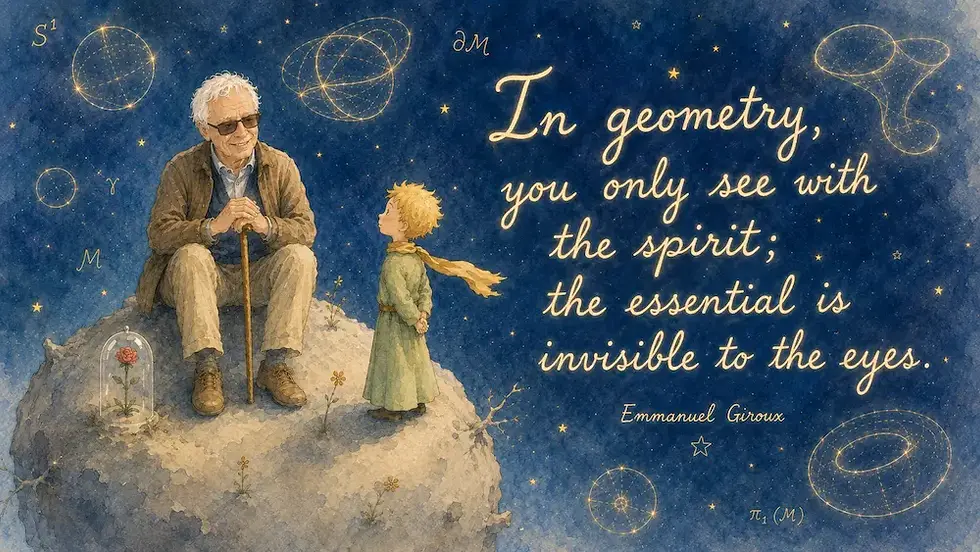
Emmanuel Giroux is director of the Unit of Pure and Applied Mathematics at the École normale supérieure de Lyon. He has been blind since the age of eleven. When people ask why he works in geometry rather than another branch of mathematics, he offers a paraphrase of the Fox from Saint-Exupéry's The Little Prince: "In geometry, you only see with the spirit; the essential is invisible to the eyes." He is not being poetic. He means it as a technical description of his method. A blind mathematician cannot work the way sighted mathematicians typically do - writing equations, reading them back, letting the formula on the page guide the next step. In geometry, Giroux works entirely with mental objects, manipulating them in his head without ever writing them down. And he has been one of the leading contact topologists of his generation.
Giroux's situation makes vivid a question the provocation already posed. The craftsmen of Isfahan were working with geometric patterns visible on tile and plaster. What Giroux works with has no surface at all. Yet both are doing mathematics. The question this raises is whether the objects they are working with exist independently of any mind that thinks about them - or whether those objects are constructions that minds produce.
The Platonist position holds that mathematical objects exist independently of human beings. This is Plato's Theory of Forms applied directly to mathematics: numbers, shapes, and ratios belong to the realm of ideal, unchanging forms that the physical world only imperfectly instantiates, and that the mind - not the senses - can access. Pi existed before any human calculated it and will remain true after the last mathematician is gone. The universe has imposed mathematics on us; our work is to discover what is already there. On this account, the craftsmen of Isfahan were reaching toward something real, and Giroux is exploring a landscape as objective as any physical territory.ed that he is dealing with an objective reality whose properties he is attempting to determine. But then, when challenged to give a philosophical account of this reality, he finds it easiest to pretend that he does not believe in it after all." The philosophical question remains open. What it decides is not trivial: the answer shapes what a proof is doing. A Platonist thinks a valid proof reveals something that was always true. A Formalist thinks a valid proof shows only that certain conclusions follow from certain axioms.
The Formalist position holds that mathematics is a human construction. Mathematicians invent axioms and rules of inference, then follow them consistently and call what follows mathematics. Whether those axioms refer to anything outside human minds is not a mathematical question - it is not even a well-formed one. The craftsmen built a beautiful and internally consistent system. That it matched quasi-crystalline physics is either a coincidence or a sign that human geometry and physical structure respond to some of the same underlying constraints, without either being the deeper truth.
Imaginary numbers give the argument its sharpest edge. In 1545, Gerolamo Cardano encountered the square root of -1 while solving cubic equations. He called it "fictitious," used it to reach correct answers, and set it aside without explanation. For two centuries, imaginary numbers worked without anyone being able to say what they referred to. In 1843, William Rowan Hamilton gave them a rigorous algebraic definition - which made them mathematically legitimate without resolving the question of their existence. In the twentieth century they turned out to be essential to quantum mechanics. Schrödinger's equation, which describes the behaviour of subatomic particles, cannot be written without them. A calculating fiction introduced in the sixteenth century is now built into the most accurate physical theory ever produced.
If imaginary numbers were invented, the question is why an invented fiction describes physical reality so precisely. If they were discovered, the question is how Cardano could use them correctly for two centuries before anyone knew what they were. Davis and Hersh capture how most working mathematicians navigate this: "the typical working mathematician is a Platonist on weekdays and a formalist on Sundays. That is, when he is doing mathematics he is convinced that he is dealing with an objective reality whose properties he is attempting to determine. But then, when challenged to give a philosophical account of this reality, he finds it easiest to pretend that he does not believe in it after all." The philosophical question remains open. What it decides is not trivial: the answer shapes what a proof is doing. A Platonist thinks a valid proof reveals something that was always true. A Formalist thinks a valid proof shows only that certain conclusions follow from certain axioms.
Big idea 2 - Whose mathematics counts?
The Scope section introduced Hardy's definition of mathematical beauty - pure, abstract, and disconnected from practical use. His distinction between "real" and "trivial" mathematics runs deeper than aesthetics. "There is the real mathematics of the real mathematicians," he wrote, "and there is what I will call the 'trivial' mathematics, for want of a better word." Applied mathematics - ballistics, aerodynamics, the mathematics of engineering - was "repulsively ugly and intolerably dull." Real mathematics "has no effects on war. No one has yet discovered any warlike purpose to be served by the theory of numbers or relativity." What the Scope section left open is the question this page pursues: whose work does Hardy's definition include, and whose does it exclude?
Abraham Wald makes Hardy's claim about war difficult to sustain. In 1943, the United States military came to the Statistical Research Group at Columbia University with a problem: fighter planes returning from combat were covered in bullet holes. The intuitive response was to reinforce the areas most heavily damaged. Wald's answer was the opposite. The returning planes were precisely the ones that could absorb hits in those places and keep flying. The data showed where a plane could be struck and survive; it showed nothing about planes struck in the engine, because those planes did not return. The holes marked the survivable damage. The fatal damage left no evidence at all. Wald's insight required no aeronautics and no engineering. It required knowing what a sample does and does not represent - the kind of abstract statistical reasoning that pure mathematical training produces. Hardy wrote in 1940 that real mathematics "has no effects on war." Wald's memo to the military may be the most direct counterexample in the history of applied statistics. not because the mathematics was wrong, but because the framework used to evaluate it excluded their way of doing it.

George Gheverghese Joseph's The Crest of the Peacock (1991) argues that Hardy's distinction is not a neutral quality judgment. It is a cultural position. The standard Hardy described - pure, abstract, proceeding from axiomatic foundations - was the standard of a particular tradition: Graeco-European mathematics. Mathematical traditions outside that tradition typically worked differently. They validated results by computation and visual demonstration rather than formal proof. They were often concerned with astronomical calculation, architectural measurement, and commercial arithmetic. By Hardy's criteria, they did not produce "real" mathematics. Joseph's argument is that this definition encoded the values of the culture that produced it. Applying it to judge non-European traditions was not a neutral assessment. It was a perspective - one that structured what counted as mathematics and, by consequence, who counted as a mathematician. As Joseph writes, mathematical traditions outside Europe "were dismissed on the grounds that they were dictated by utilitarian concerns with little notion of rigour, especially relating to proof."
Zero is one place to start. The placeholder dot that became the number zero appears in the Bakhshali manuscript, an Indian document now dated to the 3rd or 4th century - more than a millennium before it entered European mathematics. Every student using positional notation is using an Indian invention. The Kerala school of southern India takes the argument further. Around the beginning of the fifteenth century, Madhava of Kerala derived infinite series for π and for certain trigonometric functions, contributing to the beginnings of mathematical analysis approximately 250 years before Leibniz, Newton, and Gregory arrived at equivalent results through their work on infinitesimal calculus. The calculus you are studying this year has a prehistory that the standard European account of Newton and Leibniz does not tell. The Kerala mathematicians did not work within a Euclidean axiomatic tradition - their methods were computational and iterative, validated in ways that did not fit the European model of formal proof. In the standard European histories of calculus, their contribution was absent until recently - not because the mathematics was wrong, but because the framework used to evaluate it excluded their way of doing it.
Marcus du Sautoy at the Science Museum
Marcus du Sautoy on the Bakhshali manuscript - an Indian document dated to the 3rd or 4th century and the earliest known record of zero. In under four minutes he makes the case that sits at the heart of Big Idea 2: mathematics has a history, it comes from somewhere, and that somewhere is often not where the standard textbook account suggests. His aside that "very early signs of the calculus" appear in India before Newton and Leibniz is worth pausing on.
The Kerala school of southern India makes the cost of that dismissal concrete. Around the beginning of the fifteenth century, Madhava of Kerala derived infinite series for π and for certain trigonometric functions, contributing to the beginnings of mathematical analysis approximately 250 years before Leibniz, Newton, and Gregory arrived at equivalent results through their work on infinitesimal calculus. This is work we now recognise as genuinely significant. But the Kerala mathematicians did not work within a Euclidean axiomatic tradition. Their methods were computational and iterative, validated in ways that did not fit the European model of formal proof. In the standard European histories of calculus, their contribution was absent until recently - not because the mathematics was wrong, but because the framework used to evaluate it excluded their way of doing it.
The craftsmen of Isfahan bring the question back to the provocation. Lu and Steinhardt's 2007 paper established that the geometric patterns on the Darb-i Imam shrine use girih tiles capable of generating quasi-crystalline structures with perfect fivefold symmetry - structures that Western mathematics only formalised in the 1970s. The craftsmen had no axiom system, no formal proofs, no published theorems. By Hardy's definition, what they produced was not "real" mathematics. Yet it was mathematically accurate in ways that no empirical trial-and-error process would be expected to produce. Whether their knowledge counts as mathematical knowledge depends entirely on which definition of mathematics you bring to the question.
Big idea 3 - Does language shape what is mathematically thinkable?
Big Idea 1 asked whether mathematical objects exist independently of human minds or are human constructions. Big Idea 2 asked whose mathematical traditions the discipline has historically recognised as legitimate. This one goes deeper: whether the language you think in shapes which mathematical concepts are available to you at all.
The Pirahã of the Amazon, documented by linguist Daniel Everett, have no words for specific numbers. Their numerical vocabulary runs to "a few," "some," and "many." A language without number words turns out to mean something precise: a community without exact arithmetic, even when the practical need for it exists. The Pirahã are not an isolated case.
Linguist Pierre Pica spent years travelling to the Amazon to test mathematical cognition in the Munduruku, a neighbouring people whose language has number words only up to approximately five. Beyond five, their numerical vocabulary reduces to "a few" versus "many." Working with Stanislas Dehaene and colleagues, Pica found something striking. The Munduruku are excellent at approximate arithmetic - nearly as accurate as educated French adults at estimating the larger of two quantities, even with numbers up to eighty. What they cannot do is discriminate exact numbers beyond small quantities. They never count in sequence, and their number words function as approximate labels rather than precise cardinalities. The constraint is specific to exact number - the kind that depends on having precise words for each quantity. See this Guardian article from 2004.
Dehaene draws a direct conclusion: "Even the integers are manmade. They only exist in cultures that invented the notion of counting." This is a significant claim. The integers - the counting numbers that underlie arithmetic, algebra, and everything built on them - are not features of a mathematical landscape that any sufficiently intelligent mind would discover. They are cultural inventions, made possible by language. A counting system of number words makes exact number possible; without one, the difference between 12 and 13 is not available to thought.
The IB statistics course you are currently studying assumes exact numerical precision as a baseline - probability calculations and significance testing depend on it. The Munduruku research suggests that this precision is not a universal starting point. It is a cultural achievement built on language, and a relatively recent one in the history of human cognition.
The connection to the earlier Big Ideas is direct. Dehaene's conclusion about the integers places the Formalist in a stronger position: if exact integers only exist in cultures that invented counting systems, then the mathematical landscape is not simply waiting to be explored. It is partially constructed by the tools we bring to it. And if you are studying the Language optional theme on this site, the argument here connects directly to what Sapir and Whorf proposed - that the language you think in does not just describe the world, it structures what distinctions are available to thought. Mathematics, on this account, is not immune to that structuring.
A Language without Numbers
Daniel Everett spent decades living with the Pirahã of the Amazon. This short Smithsonian clip captures what his growing fluency eventually revealed: the Pirahã have no colour words, no past or future tense, and - confirmed by MIT research - may be one of the few cultures without numeracy. Pirahã mothers do not know how many children they have. They know every child's name and every child's face. Number, it turns out, is not something the mind requires in order to know what matters.

The perspective of Maths compared
A proof that holds regardless of who proves it
Mathematics presents itself as the most knower-independent of all the AOKs: a proof is valid regardless of who constructs it, which culture produced it, or what purposes it serves. This page has complicated that claim at three levels - the philosophical question of what a proof is doing, the historical question of whose traditions count as mathematics, and the cognitive question of what concepts language makes available. The ideal of knower-independence survives at the level of logical validity. It does not survive as a complete account of how mathematical knowledge is produced.
The Natural Sciences make a similar claim to objectivity and face a similar complication: replication and peer review are designed to remove the knower from the result, yet the questions scientists choose to ask, and the populations they study, reflect the perspectives of those doing the research. The comparison with The Arts points in the opposite direction: artistic knowledge openly takes the perspective of the maker as constitutive of the work, which is precisely what mathematics resists. Whether that resistance is a strength or a limitation depends on what question you are asking.
History poses the sharpest possible contrast. Perspective in History argues that who is doing the knowing shapes what gets known, as a matter of definition rather than a correctable flaw. Mathematics aims for the opposite: a proof that would hold even if every mathematician who ever checked it had thought and lived completely differently.
Human Science sits closer to History than to Mathematics on this question, but for a different reason. Perspective in Human Science argues that a sample, a diagnosis, or an economic model can quietly describe less than it claims, and serve someone more specific than everyone while doing it. A flawed proof is still checkable by anyone who follows the steps. A flawed sample can pass every internal check and still only describe the people who happened to be in it.
The Language optional theme intersects most directly with Big Idea 3, where the Munduruku and Pirahã research connects mathematical cognition to the Sapir-Whorf hypothesis. That connection is followed through directly on Perspectives in Language, where the Sapir-Whorf hypothesis gets its fullest treatment: whether the language you speak shapes not just what you can count, but what you can think at all.
Think further: questions and resources
-
Davis and Hersh describe the typical working mathematician as "a Platonist on weekdays and a formalist on Sundays" - convinced of objective reality while doing mathematics, yet retreating to formalism when pressed philosophically. Does this inconsistency undermine both positions, or does it suggest that mathematical practice and philosophical reflection are simply different activities, each with their own standards?
-
Giroux argues that geometry is the branch of mathematics a blind mathematician can do, because it works entirely with mental objects rather than written symbols. Does his case support the Platonist claim that mathematical objects are accessible to the mind independently of sensory experience, or does it show something more limited - that mental modelling can substitute for visual modelling without settling the deeper question?
-
Hardy drew a sharp distinction between "real" mathematics, which he valued for its beauty and uselessness, and "trivial" mathematics, which he dismissed as dull. Joseph shows that this distinction excluded most non-European mathematical traditions on the grounds that they were practical rather than pure. Is the distinction between pure and applied mathematics a genuine difference in mathematical quality, or a cultural preference that was given the authority of a definition?
-
Wald's survivorship bias insight came entirely from abstract statistical reasoning - no knowledge of planes, engines, or combat was required. Does this support Hardy's view that pure mathematical training is the highest form, or does it suggest the pure/applied distinction was never as meaningful as Hardy claimed?
-
Dehaene concludes that "even the integers are manmade - they only exist in cultures that invented the notion of counting." If the Munduruku have sophisticated approximate arithmetic but no exact integers, is something missing from their mathematical knowledge, or do they have a different but equally coherent relationship to number? What would it mean to answer that question from outside their culture?
-
Mathematics is often described as the most knower-independent of the AOKs: a proof is valid regardless of who produces it. This page has identified three levels at which perspective enters - philosophical, historical, and linguistic. Which of the three do you find most challenging to the knower-independence claim, and why?
Films
For more see my 10 films for the TOK journey page.
🎬 WATCH — Is math discovered or invented (2015)
Matt Brown.
This video explores the ancient debate over whether mathematics is discovered or invented. Platonists, from Pythagoras to Euclid, saw numbers and geometry as real features of the universe. Formalists, such as Hilbert and Poincaré, argued that mathematics is a human-made system of rules. Wigner’s “unreasonable effectiveness” of mathematics supports discovery, since abstract ideas later explain reality. Examples include Hardy’s number theory, Fibonacci patterns, Riemannian geometry, and knot theory in DNA.
🎬 WATCH — The story of maths (1996)
BBC Open University
In The Genius of the East, Marcus du Sautoy challenges the idea that mathematics was mainly a European achievement. After Greek decline, he shows how China used mathematics for engineering and administration, India developed zero, negative numbers, infinity and trigonometry, and Islamic scholars created algebra. The episode presents mathematics as a global story of exchange, translation and migration, ending with Fibonacci bringing Eastern numerical ideas into Europe and helping transform Western mathematics.
Further reading
📚 READ - The Mathematical Experience by Philip J. Davis and Reuben Hersh (1981)
Do not try to read this cover to cover. Start with Part 1, "The Mathematical Landscape," which sets out what mathematics is, what mathematicians actually do, and why the philosophical questions resist easy answers. Then find the section "The Philosophical Plight of the Working Mathematician" (p. 359) - this is the passage in the reader, and it rewards reading in its full context. Davis and Hersh are unusual: they are working mathematicians who take the philosophical questions seriously without pretending they are settled. In the library in TOK Books > Maths.
📚 READ - What Is Mathematics, Really? by Reuben Hersh (1997)
Hersh is the co-author of The Mathematical Experience and this is his solo argument. Where that book surveys the landscape, this one takes a position: mathematics is neither a Platonic object existing independently of human minds nor a meaningless formal game, but a social institution - part of human culture, produced by human communities, and comprehensible only in that context. The argument runs directly against both positions in Big Idea 2, and Hersh is good at showing exactly where Platonism and Formalism break down under pressure. Part 1 makes the case; Part 2 is a history of philosophy of mathematics that puts the debate in context. In the library in TOK Books > Maths.
📚 READ - Jordan Ellenberg, How Not to Be Wrong: The Power of Mathematical Thinking (Penguin, 2014).
Chapter 1 tells the Wald story in full, including his background as a Jewish refugee from Nazi-occupied Vienna and the irony of a man fleeing fascist violence working to save Allied pilots while his family was killed in the Holocaust. The chapter is also the best account of why Wald's insight is genuinely mathematical, not just common sense dressed up. In the library in TOK Books > Maths.
📚 READ - The Crest of the Peacock: Non-European Roots of Mathematics by George Gheverghese Joseph (third edition, 2011)
Read the Preface to the Third Edition - the reader extract - and then Chapter 1, "The History of Mathematics: Alternative Perspectives." Chapter 1 makes the full argument that the standard history of mathematics reflects the conditions of its institutionalisation as much as the distribution of mathematical achievement. If Big Idea 3 interests you, the chapters on Indian mathematics (Chapters 8 and 9) give the Kerala school material in proper depth: the infinite series results, what Madhava actually did, and what the transmission failure meant. In the library in TOK Books > Maths.
📚 READ - The Number Sense: How the Mind Creates Mathematics by Stanislas Dehaene (revised edition, 2011)
The reader uses the Munduruku section from the "Fifteen Years Later" epilogue. Read the full epilogue (pp. 225-274): it is the most accessible part of the book and places the Munduruku research in its larger context - what it tells us about approximate versus exact number, and what it leaves open about the relationship between language and mathematical thought. If you want the foundational argument, Chapters 1 and 3 explain the innate number sense hypothesis that the Munduruku research is testing. In the library in TOK Books > Maths.
📚 READ - Pi in the Sky: Counting, Thinking, and Being by John D. Barrow (1992)
The most direct engagement with the philosophical questions on this page that is also written for a general reader. Barrow covers the nature of mathematical existence, the Platonic and formalist positions, the unreasonable effectiveness problem, and the relationship between mathematics and physical reality - across human cultures and across history. If you want one book that pulls the threads of all three Big Ideas together and takes them seriously as philosophical problems, this is it. In the library in TOK Books > Maths.
📚 READ - "The Unreasonable Effectiveness of Mathematics in the Natural Sciences" by Eugene Wigner (1960)
The reader contains an extract. Read the full essay - it is fourteen pages. Wigner's argument is that the fit between mathematics invented for purely internal reasons and the structure of physical reality cannot be explained by anything currently understood, and that this ought to disturb us more than it does. The opening anecdote about pi and population statistics sets the tone: plain common sense, Wigner says, is actually on the side of finding this strange. Available in the library in TOK Books > Maths.