

areas of knowledge - NAtural science
Perspective in Natural Science
What does any scientific framework make visible - and what does it make impossible to ask?
THE PROVOCATION
Same data. Different conclusion.
Frances Kelsey
Frances Kelsey joined the FDA in 1960 and was assigned what her colleagues expected to be a routine review. The video follows her refusal to approve thalidomide, and the months of pressure from the manufacturer that followed. By the time European markets withdrew it, tens of thousands of children had been affected. The United States had not approved it. Kelsey and the European regulators examined the same data. Why did they see different things in it?
Frances Kelsey's first case as a medical reviewer was a new sedative called thalidomide, already approved and in wide use in Europe and Canada as a treatment for morning sickness and insomnia. The manufacturer, Richardson-Merrell, expected quick American approval. Kelsey refused. Her reasons were specific. The company's safety data was built on adult studies. Kelsey noticed that thalidomide behaved differently across animal models, which gave her reason to doubt the assumptions being extrapolated from those studies. She also found the evidence on how the drug crossed biological membranes - including the placenta - inadequate. Richardson-Merrell applied direct pressure on Kelsey and her superiors. She continued to ask for more evidence.
In November 1961, William McBride in Australia and Widukind Lenz in Germany independently identified thalidomide as the cause of severe limb malformations in newborns. Tens of thousands of children in Europe and Canada had been affected. The United States had been largely spared. The question this case opens is not why Kelsey was right. The question is what made her see something in the data that the European regulators had not. She and they examined the same evidence. What made the difference was what each observer was looking for when they came to it.
The Kelsey case opens several questions at once. The most immediate is about the individual observer: what any framework makes possible to see, and what it forecloses. Behind that is a question about the scientific community: paradigms are social institutions that determine which anomalies get taken seriously and which get explained away. Behind that is a question about power: who funds the research, who controls what gets published, and whose prior knowledge gets written into or out of the record. The three sections below move through those layers in order.
Big idea 1 - What you are looking for shapes what you find
Robin Wall Kimmerer, botanist, plant ecologist, and member of the Citizen Potawatomi Nation, was introduced in Core Lesson 4 in the context of whose knowledge receives institutional recognition. This page takes up a related question: what any observational framework makes possible to see, including frameworks that claim objectivity as their foundation. The example that opens her argument is the moment a graduate adviser told her that wanting to understand why goldenrod and asters look beautiful together was an unscientific question. The framework she was trained in asked "How does it work?" rather than "Who are you?" or "What can you teach us?" This narrowing determines what can be asked, and what can be named.
Kimmerer describes learning the Anishinaabe word Puhpowee: "the force which causes mushrooms to push up from the earth overnight." Western scientific vocabulary has no equivalent term. She writes that "in scientific language our terminology is used to define the boundaries of our knowing. What lies beyond our grasp remains unnamed." A framework determines what can be studied and what can be described.
The mycorrhizal networks now central to plant ecology - underground fungal connections between trees that redistribute nutrients and allow a forest to function as a collective - were relationships that Indigenous ecological knowledge had described long before Western botany developed the tools to document them. They were real, but the knowledge was ignored by science.

The same problem operates within Western science itself. When a discipline specialises deeply enough, each researcher examines their part of the problem with rigour and confidence - and loses sight of what the parts add up to. The mycorrhizal network story is partly a story about this: plant biologists studying individual plants, soil chemists studying soil composition, ecologists studying community dynamics. The network became visible only when someone asked about relationships across those boundaries. Kimmerer's argument is that Indigenous ecological frameworks, which treat the forest as a community of relationships rather than a collection of individual organisms, were structurally better placed to see what was there.

The Kelsey case makes the same point at the level of regulatory science. She and the European regulators examined the same thalidomide data. What differed was the framework each reviewer brought to the data. She asked what happened to the drug across different animal models and whether the evidence on placental transfer was adequate; the European regulatory frameworks had set different thresholds for what adequate evidence looked like.
In your chemistry and biology labs, the decision of what to measure, which variables to control, and what counts as a valid result all embed prior assumptions about what kind of answer the experiment is designed to produce. A framework is never absent from an observation; the question is which framework is operating.
Big idea 2 - Scientific communities are social institutions - and that shapes what anomalies look like
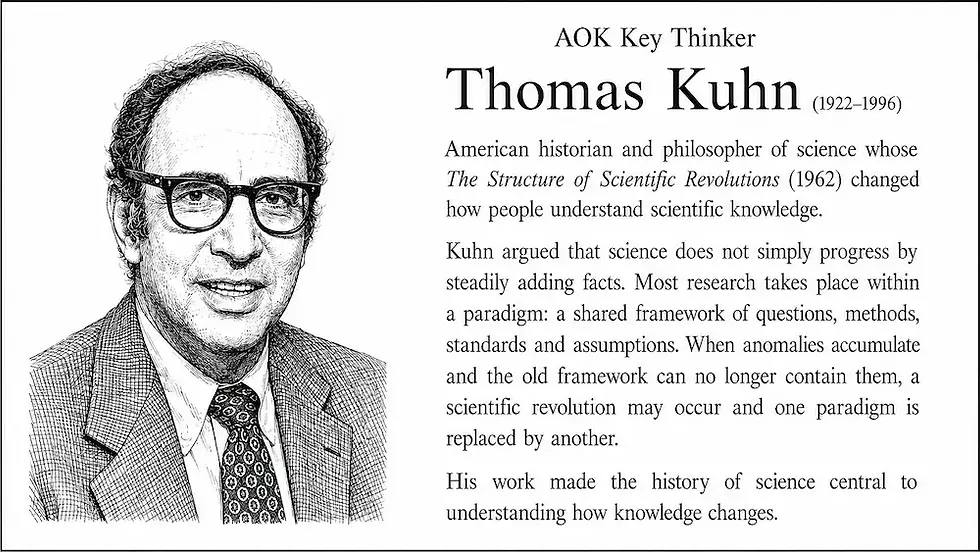
Thomas Kuhn's argument in The Structure of Scientific Revolutions is usually read as a claim about the logic of paradigm shifts. Core Lesson 5 covered that logic: the asymmetry between verification and falsification, why a single anomaly rarely overturns a paradigm, and what a scientific revolution involves. The aspect of Kuhn's work this section focuses on is the social structure that produces that logic.

A scientific community does not just share methods. It shares assumptions about what counts as a legitimate question, what anomalies are worth investigating, and what kinds of evidence are sufficient to settle a question. These assumptions are rarely stated. An observation that does not fit gets explained away, filed as experimental error, or set aside. It is rarely treated as an immediate challenge to the framework.
Barry Marshall's case illustrates how far this can extend. In 1984, Marshall was a young gastroenterology researcher in Perth who had become convinced that stomach ulcers were caused by a bacterium. The paradigm said the stomach was too acidic for bacteria to survive. His findings were dismissed: the mechanism did not fit, and the dominant explanation accounted adequately for ulcers as stress-related. Unable to get his results published convincingly, Marshall drank a solution containing Helicobacter pylori, developed gastritis, and treated it with antibiotics. He and Robin Warren received the Nobel Prize in Physiology or Medicine in 2005.
Lynn Margulis encountered the same structure. She proposed that mitochondria and chloroplasts in eukaryotic cells were once free-living bacteria that had been incorporated rather than evolved from within. Her paper was rejected repeatedly before publication in 1967. The theory is now foundational in cell biology. The mitochondria you encounter in Maturite Biology - the organelles whose structure and function the curriculum describes in detail - are there because Margulis asked a question the paradigm had made difficult to take seriously.
In both cases, the evidence was present. The paradigm provided reasons not to take it seriously.
The psychological mechanisms Core Lesson 6 described at the level of the individual operate at the level of the paradigm community too. Mercier and Sperber's argue that reason evolved to win arguments rather than to find truth, which means scientists reasoning within a paradigm are systematically more alert to the weaknesses in challenges to their position than to the weaknesses in the position itself. Marshall's colleagues set out to evaluate his finding using cognitive equipment that was primed to find it implausible.

Big idea 3 - Power determines whose knowledge gets funded, credited, and endorsed
Sandra Harding, in Whose Science? Whose Knowledge?, identifies a problem with the conventional ideal of scientific objectivity. The standard requirement - that scientists remove their own perspective from their work - eliminates individual bias while leaving unexamined the background assumptions about which questions are worth asking, which populations are worth studying, and what findings count as significant. Harding calls this "weak objectivity." The institutional perspective embedded in the research programme goes unexamined.
Her alternative is "strong objectivity": extending critical scrutiny to include those background assumptions. This means starting from questions the dominant framework has not asked, and from the experiences of communities marginalised within the knowledge-producing institution. The claim is that knowledge produced this way is less partial. The dominant perspective does not see its own assumptions because it has no occasion to.
As we saw in the Maths AOK, George Joseph, in The Crest of the Peacock, documents mathematical and scientific traditions developed in Babylon, Egypt, India, and China that anticipated results later attributed to European scientists by centuries. The attribution history that textbooks reproduce reflects decisions made at a specific historical moment by communities with specific institutional interests. The Pythagorean theorem holds regardless of whether Babylonian mathematicians knew the relationship before Pythagoras. The attribution of the result to Pythagoras is a historical decision, not a mathematical one.
The same question extends from the attribution of past discoveries to what gets treated as a legitimate subject of study in the present. When women's psychological distress in the 1960s was characterised primarily as a neurochemical condition, the framework reflected an absence: the communities whose experience would have raised a different set of questions were not the ones designing the studies. Betty Friedan, in The Feminine Mystique (1963), documented the same distress from outside the specialist framework and located its source in the social conditions of women's lives. The framework had no mechanism to authorise the experiences Friedan described as medical evidence.
Funding sustains this pattern. The research that defines what a scientific community accepts as established is largely sponsored by industries with a stake in the outcome. Trials with positive results are consistently more likely to be published than trials with negative results - a structural bias Ben Goldacre documents in Bad Pharma (2012). The serotonin hypothesis of depression shows how this operates over time: the hypothesis justified SSRIs, a drug class generating billions in revenue, and the industry that profited had little incentive to fund trials that might weaken it. When Moncrieff et al. published their 2022 review in Molecular Psychiatry and found no consistent evidence for the hypothesis, they were identifying a claim that had been institutionally endorsed long after the evidence for it had ceased to be clear.
The provocation closes the loop. Richardson-Merrell applied direct pressure on Kelsey and her superiors because approval was commercially urgent. The framework that determines what counts as sufficient evidence is shaped in part by who is funding the studies that build it. Your IB Maths exploration asks you to select and justify a method: Harding's question is whether the method you select was designed to answer your question, or someone else's.
The perspective of Natural Science compared
The empirical test does not run itself
The perspectives debate looks different in each AOK because what "perspective" means depends on what kind of knowledge is being produced.
In Mathematics, the perspectives debate is largely ontological: mathematicians disagree about what mathematical objects are - whether they exist independently of minds (Platonism), whether they are human constructions (social institutionalism), or whether they are grounded in embodied experience (Lakoff and Nunez). The disagreement is about the nature of the objects, not primarily about who is looking at them.
In Natural Science, the debate shifts. The objects being studied - bacteria, drug compounds, forest networks - exist independently of the observer. The perspectives question is not what they are but what any given framework makes it possible to observe about them, and whose institutional interests shape which observations get funded, published, and credited. Perspective enters at the level of method, institution, and power rather than at the level of ontology.
History offers a further contrast. In History, perspective shapes which events get into the record in the first place - Trouillot's four moments of silence operate before interpretation begins. In Natural Science, the data is more often present; the question is what framework determines whether it counts as significant. Marshall's data existed. The paradigm provided reasons to set it aside.
Perspective in Human Science and Perspective in the Arts sit at the far end of this same question, each in its own way. Human Science studies subjects who know they are being studied and can change in response, which Kimmerer’s and Marshall’s cases above do not involve. The Arts go further still: Perspective in the Arts argues that perspective is not something to correct for at all, but part of what a work means.
The comparison that cuts deepest is with the AOKs that lack Natural Science's commitment to empirical testing. Science's insistence on evidence as the arbiter of disputes appears to place it beyond the reach of perspective. What BI2 and BI3 together show is that the social and financial structures surrounding empirical testing shape which tests get run, which results get published, and which findings get endorsed as consensus - before any individual scientist applies their perspective to the data.
Think further: questions and resources
-
Kimmerer describes asking her graduate supervisor why asters and goldenrod look beautiful together and being told it was an unscientific question. Does her case show that Western scientific frameworks are incompatible with certain kinds of knowledge, or that they are incomplete - capable of asking those questions but not yet organised to do so?
-
Barry Marshall could not get his H. pylori findings published, so he drank the bacterium to produce evidence the paradigm could not dismiss. Does his case support Popper's claim that science advances through falsification, or does it show that the social dimension Kuhn describes operates even when the evidence is unambiguous?
-
Harding argues that "weak objectivity" - removing the individual observer's perspective - leaves unexamined the background assumptions about which questions are worth asking. Her critics argue that introducing the researcher's social position into the methodology is a political intervention, not an epistemic improvement. What would it take for this dispute to be settled empirically rather than philosophically?
-
Goldacre documents that trials with positive results are roughly twice as likely to be published as trials with negative results - a bias built into the system before any individual scientist acts. Does this undermine the claim that evidence-based medicine is evidence-based, or only the claim that current practice lives up to that standard?
-
Kuhn treats the social embedding of paradigms as a feature that makes normal science productive - without shared assumptions, every anomaly would be a crisis. Harding treats the same embedding as a distortion correctable through strong objectivity. Are these genuinely opposed positions, or are they describing different problems?
-
Kelsey and the European regulators examined the same thalidomide data and reached different conclusions. If what differed was the framework each reviewer brought to the data, can scientific disagreement be settled by examining the data more carefully - or only by examining the frameworks?
Films
For more see my 10 films for the TOK journey page.
🎬 WATCH — And the Band Played On (1993)
Roger Spottiswoode
And the Band Played On follows Don Francis and colleagues at the CDC as they attempt to understand and respond to the early AIDS epidemic. The epidemiological picture became clear relatively early. What followed was a question of what different institutional perspectives could do with that evidence: the political constraints on acknowledging which communities were affected, the blood bank industry's resistance to precautionary testing, and the gap between what the science showed and what institutions were able to act on. The film is the BI2 argument at the scale of public health - a failure of what different frameworks authorised as a response to what was observed.
🎬 WATCH — Dark Waters (2019)
Todd Haynes
Dark Waters follows corporate defence attorney Rob Bilott as he spends two decades building a case against DuPont after discovering the company had conducted internal research showing that PFAS chemicals in the water supply near their Parkersburg, West Virginia plant were causing cancer - and had suppressed it. The film makes the BI3 argument with unusual precision: DuPont funded the studies, controlled access to the data, and the regulatory framework set thresholds based on what the company chose to submit. The evidence existed. The system was structured so that it would not reach the people it concerned. What Goldacre describes as a structural bias in published research, Dark Waters shows operating at the scale of a community's water supply over fifty years. My students can watch the film here.
Further reading
📚 READ - Braiding Sweetgrass by Robin Wall Kimmerer (2013)
The chapter "Asters and Goldenrod" is the argument at the centre of Big Idea 1 - the question Kimmerer was told was not science, and what that refusal reveals about what the framework had authorised as knowable. Read it in full before encountering any extract in isolation. The following chapter, "Learning the Grammar of Animacy," extends the argument into language: what Potawatomi makes possible to say about the living world that scientific English cannot, and what that difference tells us about the relationship between vocabulary and knowledge. Kimmerer is a credentialed plant ecologist making an epistemological argument from inside the discipline she is critiquing. Both chapters are short and in the first section of the book. In the library in TOK Library > Indigenous knowledge.
📚 READ - Whose Science? Whose Knowledge? Thinking from Women's Lives by Sandra Harding (1991)
Chapter 6, "Strong Objectivity and Socially Situated Knowledge" (pp. 138-163), is the philosophical core of Big Idea 3. Harding's distinction between "weak objectivity" - the conventional ideal that removes the individual observer's perspective - and "strong objectivity" - which subjects the background assumptions of the research programme to the same critical scrutiny applied to evidence - is the argument that pulls the rest of the page together. The Introduction (pp. 1-18) maps the debate Harding is entering and is worth reading first if the Chapter 6 argument raises more questions than it settles. In the library in TOK Library > Science.
📚 READ - Bad Pharma by Ben Goldacre (2012)
Start with Chapter 1, "Missing Data." The first 40 pages establish the core argument: how trials with negative results are routinely suppressed, how regulators accept the data companies choose to submit, and how the evidence base that informs prescribing practice is structurally incomplete before any individual doctor reads it. Goldacre is a practising physician and academic statistician; the book is addressed to clinicians as much as to general readers, which gives it a different texture from most popular science writing on the same subject. The rest of the book documents the mechanisms case by case - worth dipping into if the opening argument interests you. In the library in TOK Library > Science.
📚 READ - The Structure of Scientific Revolutions by Thomas S. Kuhn (1962)
The Scope in Natural Science reader uses the Introduction (pp. 5-6). This page draws on a different part of Kuhn's argument. Read Chapters III and IV, "The Nature of Normal Science" and "Normal Science as Puzzle-solving" (pp. 23-42), which develop what it means for a scientific community to share not just methods but assumptions about what problems are worth solving and what solutions look like. Chapter VI, "Anomaly and the Emergence of Scientific Discoveries" (pp. 52-65), follows directly and is where the Marshall and Margulis cases find their theoretical home: what happens when an observation refuses to be explained away. In the library in TOK Library > Science.