

areas of knowledge - the arts
Ethics in the Arts
An artist can use someone else's suffering, serve a cause history has condemned, or hold an object taken from the people who made it. None of that is settled by whether the finished work is good.
Six hours, seventy-two objects
THE PROVOCATION
Marina Abramović narrates Rhythm 0
In this 2014 film, Marina Abramović narrates Rhythm 0 in her own words, decades after the performance. She describes the audience's shift from gentle curiosity to open aggression, and the moment a loaded gun was pointed at her head. No footage of the 1974 performance survives, only her retrospective account. An audience willing to point a gun at another person raises the question this page returns to: once art hands an audience power to act, who answers for what follows?
In 1974, Marina Abramović stood for six hours in a gallery in Naples, from eight in the evening until two in the morning, beside a table holding seventy-two objects: a rose, a feather, honey, bread, wine, scissors, a scalpel, nails, a metal bar, a gun, a single bullet. Her instructions to the audience read in full: "There are 72 objects on the table that one can use on me as desired... I am the object... During this period I take full responsibility."


The art critic Thomas McEvilley was in the room. His account: "It began tamely. Someone turned her around. Someone thrust her arms into the air. Someone touched her somewhat intimately... In the third hour all her clothes were cut from her with razor sharp blades. In the fourth hour the same blades began to explore her skin. Her throat was slashed so someone could suck her blood... When a loaded gun was thrust to Marina’s head and her own finger was being worked around the trigger, a fight broke out between the audience factions." Abramović herself put it plainly, years later: "What I learned was that... if you leave it up to the audience, they can kill you... I felt really violated: they cut up my clothes, stuck rose thorns in my stomach, one person aimed the gun at my head, and another took it away." After six hours, as planned, she stood up and walked toward the audience. Everyone ran. Nothing in the room changed over those six hours. The rose was still a rose, the gun was still a gun. What changed was what the audience believed they were now permitted to do, once an artist had signed away the right to stop them. Rhythm 0 makes one kind of responsibility impossible to miss: the audience’s, once an artist hands them the power to act rather than just to look. The rest of this page asks who else answers for a work once it exists: the artist who depicts someone, the artist being judged for what they made or served, and the institution deciding what happens to it next.
Big Idea 1 asks what an artist owes someone else whose suffering becomes the subject of a work, and whether making that suffering visible helps them or uses them. Big Idea 2 asks whether a work’s value can be judged apart from the person who made it, or the cause it was made to serve. Big Idea 3 asks who has the right to own, display or return a work once it has left the community and the place that gave it meaning.
Big idea 1 - Kevin Carter - does photographing someone else’s suffering serve them, or only the photographer?
Manic Street Preachers - Kevin Carter
Kevin Carter was released by the Welsh rock band Manic Street Preachers in 1996. The lyrics were written by Richey Edwards, while the music was composed by the band. It appeared on Everything Must Go, their first album released after Edwards’s disappearance in 1995. Issued as a single, it reached number nine on the UK Singles Chart. Its prominent trumpet part and tightly driven arrangement contributed to the broader, more ambitious sound that brought the band major commercial success.
Most people who know this song have never seen the photograph it is about, or heard the story behind it. In 1996 Manic Street Preachers released "Kevin Carter" as the third single from the massively successful fourth album Everything Must Go, naming the photojournalist directly. It is my favourite album by my favourite band. I also happened to be in the same class at University with two of the band. It reached number nine on the UK singles chart, turning Kevin Carter into a lyric millions of people have sung along to without knowing why. Before the song there was a photograph. Before the photograph there was a choice, made by a photographer in a famine camp in South Sudan. Working backward from the song to that choice is one way into this Big Idea.
The philosopher Martha Nussbaum argues that emotion itself is a way of knowing, not just something that happens on the way to it. In her own words: "the most important truths about human psychology cannot be communicated or grasped by intellectual activity alone: powerful emotions have an irreducibly important cognitive role to play." A novel or a painting can place a viewer inside a situation they have never lived through, in a way abstract reasoning cannot. But that access has a limit built into it. Feeling moved by a depiction of someone else’s suffering is not the same as understanding it accurately, and it creates no automatic obligation to do anything at all.
Kevin Carter - The vulture picture

Kevin Carter (1960–1994) was a South African conflict photographer who documented the extreme violence surrounding the final years of apartheid. As a member of the “Bang-Bang Club,” he worked close to township fighting, political killings and public executions, believing photographs could expose events hidden from distant audiences. Kevin Carter’s 1993 photograph of a starving child in South Sudan, published in the New York Times, shows the child collapsed on the ground with a vulture waiting nearby. The photograph won Carter the 1994 Pulitzer Prize and made the famine visible to millions of readers who would never otherwise have seen it. It also provoked a different accusation: readers wanted to know why Carter had photographed the child instead of helping her. By his own account, Carter waited around twenty minutes near the child, hoping the vulture would spread its wings for a more dramatic frame, before he chased the bird away; photojournalists working in the region had been warned not to touch famine victims, for fear of spreading disease, and were accompanied by armed guards whose job was to stop them intervening. The criticism followed him regardless, and he took his own life the following year.
A more infamous version of the same case comes from the war in Vietnam. In March 1968, the US Army sergeant Ronald Haeberle was serving as a photographer attached to the unit that carried out the My Lai massacre. He photographed Vietnamese women and children moments before soldiers shot them, the last photographs taken of them alive, then turned away and heard the shots.
He offered the photographs to a Cleveland newspaper the following year; Life Magazine published them in December 1969, twenty months after the massacre, and My Lai went from a barely reported incident to the defining atrocity of the war.
In the film below - which you will have already seen in my history class - media scholar Susan Moeller argues that photographing war and atrocity is not just permissible but necessary: a photograph can create evidence a government cannot suppress or deny, forcing a public reckoning that words alone do not.


Vietnam: The Camera at War
Susan Moeller reflects on Ronald Haeberle’s My Lai photographs, arguing that most war photographers understood bearing witness, not intervening, as their role. Don McCullin admits to the one photograph he staged himself: a dead North Vietnamese soldier’s belongings, gathered and photographed as a deliberate statement, made because the man could no longer speak for himself. The YouTube algorithm finds the film too shocking to be embedded here, so please click through to watch. (3 minutes 35)
McCullin's account of his own career is unresolved rather than settled: he has said he never felt entirely comfortable with what he was doing, that recording the dead felt like the only statement he knew how to make, and that a photographer who breaks down in the field, like a surgeon who faints at the sight of blood, cannot do the job at all. In 1968 he found a dead North Vietnamese soldier whose belongings had been scattered by American marines searching for souvenirs, who then walked away making derogatory remarks about him.
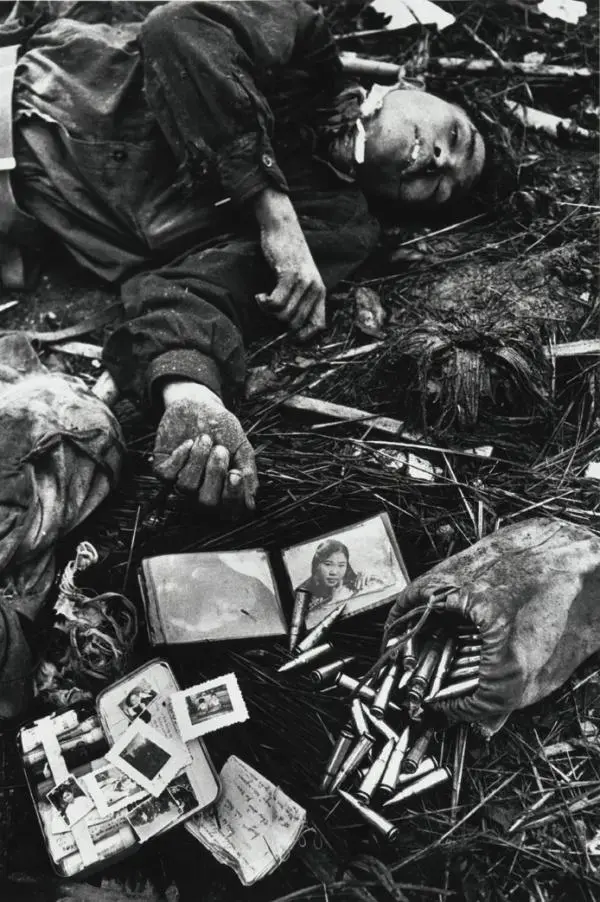
In his own words: "I decided this wasn’t right. This man had sacrificed his life. He was an innocent young man fighting for national reunification. He had a bullet through his teeth and his brains were shot out of the back of his head. He deserved a voice. He couldn’t speak, so I was going to do it for him. I shovelled his possessions together, his pictures of his family, his pathetic little medical kit and his bag of bullets, and photographed them at the foot of his dead body. That’s the only contrived picture I’ve taken in a war. I know it was staged, but I did it as a statement." Carter’s twenty-minute wait is a smaller version of the same situation. Neither photograph simply records what was already there when the photographer arrived. McCullin built a composition to make an argument about a dead man’s humanity. Carter waited for a more affecting arrangement of a bird’s wings before he acted.
Photojournalism claims an authority painting does not: that the photographer only witnesses and records, rather than composes. However, the moment a photographer chooses a composition, a wait, an arrangement, they have stopped only recording and started making the kind of decision a painter makes.
Susan Sontag traced this same doubt back to the most famous war photograph ever taken. Robert Capa’s "The Death of a Republican Soldier" (1936) shows a Spanish militiaman collapsing at the instant a bullet hits him. For decades, suspicion has circled the image; one hypothesis holds it records a training exercise rather than real combat. Sontag argued the doubt itself carries the weight: "The point of 'The Death of a Republican Soldier' is that it is a real moment, captured fortuitously; it loses all value should the falling soldier turn out to have been performing for Capa’s camera." She placed Carter and McCullin on the far side of a line drawn by a later war: "Only starting with the Vietnam War is it virtually certain that none of the best-known photographs were setups. And this is essential to the moral authority of these images."
Robert Capa - The Falling Soldier

Sontag knew McCullin’s own work directly, not just as a general case. During the 1982 Falklands campaign, Margaret Thatcher’s government admitted only two photojournalists to the war zone; Sontag named McCullin, "a master war photographer," as one of those refused. She later wrote the preface to a 2002 collection of his photographs. The photographer whose staged image of a dead soldier’s belongings opened this section is the same photographer Sontag chose, out of everyone taking pictures of war, to introduce to readers in his own book.

Soon after the suicide of Kevin Carter, Richey Edwards, the Manic’s rhythm guitarist, wrote the lyric to the song in the autumn of 1994. James Dean Bradfield set it to music and played it back to him on acoustic guitar shortly before Edwards disappeared, on 1 February 1995, the day he and Bradfield were due to fly to the United States for a promotional tour. His car was found seventeen days later near the Severn Bridge, a location associated with suicide; he was never found, and his family had him declared legally presumed dead in 2008. Everything Must Go was assembled from the lyrics he left behind. A song about one man’s suicide carries, unheard by most of the people who sing along to it, the words of another man presumed to have taken his own life within months of writing them.
Big idea 2 - Riefenstahl - can a work’s value be judged apart from the cause it served, or the person who made it?
Triumph of the Will and Star Wars
My short film opposite places images from Triumph of the Will beside scenes from Star Wars (1977). The similarities are difficult to miss: monumental architecture, rigid symmetry, massed ranks, elevated leaders and ceremonial processions designed to make power appear overwhelming.
Does it matter? That is the question Big idea 2 is concerned with.
George Lucas's Star Wars did not reproduce Nazi ideology, but he drew on a visual language that Leni Riefenstahl had helped innovate. Big Idea 1 already showed that cameras do not simply capture reality. Kevin Carter waited for a stronger composition. Don McCullin arranged a dead soldier’s possessions to make a statement about his humanity. In both cases, the photographer selected and organised what the viewer would see.
Riefenstahl applied the same principle on a far larger scale. In Triumph of the Will, the rally, the architecture, the camera positions and the editing combine to turn a political event into a complete visual argument. Hitler commissioned Riefenstahl to film the 1934 Nazi Party rally at Nuremberg. The Nazi regime provided the almost unlimited funds for Riefenstahl to realise her artistic vision. Released the following year, the film used multiple moving cameras, elevated viewpoints, repeated patterns and rhythmic editing to present Hitler not merely as a politician but as the centre of a unified national destiny. It contains little explanatory narration because it does not need it. The images themselves organise what the audience is invited to feel.
Riefenstahl later insisted that she had documented the rally rather than created propaganda. But the film was not a neutral record of an event that existed independently of the camera. Platforms and tracks were built to provide particular shots, while months of editing shaped the footage into a carefully controlled sequence. The apparent reality of the rally was partly constructed for the camera, and the finished film then presented that construction as natural and inevitable.
Walter Benjamin identified the danger at the time. Fascism, he argued, turns politics into an aesthetic experience. In Triumph of the Will, beauty is not an innocent quality added to propaganda. Beauty is how the propaganda works. The philosopher Nelson Goodman used the term “rightness” rather than truth to describe whether a work succeeds on its own terms. Riefenstahl’s film is formally right in this sense: its composition, rhythm and scale achieve exactly the effect intended. But that success cannot be separated from its moral purpose. The same qualities that make the film artistically powerful make its political vision persuasive.
The real question, then, is whether artistic excellence remains ethically neutral when composition, beauty and technical skill are precisely the means by which an immoral vision becomes convincing. Riefenstahl’s case concerns wrongdoing built into the purpose of a work. Picasso’s case, next, concerns wrongdoing in the life of the person who made one.
Pablo Picasso - Guenica

This will also be familar from our history lessons. Guernica also began as a state commission, though a very different one. In 1937 the Spanish Republican government commissioned Picasso to paint a mural for its pavilion at the Paris International Exposition, hoping the world’s fair would win international sympathy while it lost ground in the civil war at home. Picasso lived in Paris, held no office and owed the Republic no obedience; it could not compel him to accept the commission or punish him for what he painted. He had not settled on a subject until he read newspaper reports of the bombing of the Basque town of Guernica on 26 April 1937, carried out by Nazi Germany’s Condor Legion and Italian fascist bombers in support of Franco’s Nationalist forces. Picasso, who was not present at the bombing and had no personal stake in the town, painted the mural in Paris over the following weeks: a monochrome scene of a screaming horse, a dismembered soldier, a mother holding a dead child, a bull looking on. It was unveiled at the Spanish Pavilion that July, addressed to an international audience the Republic hoped might still intervene.
Both, then, were state commissions, but the states involved could not be more different. Riefenstahl’s government held real power over her life and career, and could reward or destroy her for what she made. Picasso’s government was losing a war and had no power over him at all; it could only ask, and hope international opinion would do what its own army could not. Goodman’s test does not sort these cases for us. Rightness only asks whether a work succeeds on its own terms. It says nothing about who commissioned it, who it defends, or who it was made to persuade.
Guernica raises a second version of this Big Idea’s question, one the painting itself cannot answer: does knowing about the painter change how the painting should be judged? Picasso’s own conduct toward the women in his life is extensively documented. He met Marie-Thérèse Walter when she was seventeen and he was forty-five. Françoise Gilot, who was with him for a decade from the age of twentyone, later wrote that he told her: "Women are machines for suffering," and "For me there are only two kinds of women: goddesses and doormats." His granddaughter Marina Picasso, in her own memoir, wrote that he "submitted them to his animal sexuality, tamed them, bewitched them, ingested them, and crushed them onto his canvas." Two of the women in his life, Marie-Thérèse Walter and his second wife Jacqueline Roque, later took their own lives.
Both works can be masterpieces by Goodman’s standard, but rightness reaches its limit in different ways. In Riefenstahl’s film, artistic rightness and moral wrongness are fused: the more successfully the composition, scale and editing work, the more persuasive the propaganda becomes.
Guernica is different. Its formal success does not depend on how Picasso treated the women in his life. The painting’s artistic achievement and the artist’s cruelty arise from the same biography, but one is not the means by which the other works.
Rightness therefore leaves the ethical question unanswered for opposite reasons. With Riefenstahl, the artistic success is inseparable from the wrongdoing the work performs. With Picasso, the wrongdoing lies outside the work’s formal operation, even though knowing about it may change how an informed viewer encounters the painting.
Big idea 3 - The Just Judges - what responsibilities come with holding, displaying or replacing a work of art?
Ghent Altarpiece - World's most stolen painting
This animated film traces the extraordinary history of the Ghent Altarpiece, described as the world’s most frequently stolen artwork. Napoleon’s forces removed panels to Paris, others were sold to collectors in Berlin, and Nazi troops later seized the reunited altarpiece during the Second World War. Its most mysterious loss came in 1934, when the Just Judges panel disappeared from St Bavo’s Cathedral. Despite ransom letters, confessions and decades of investigation, the original panel has never been recovered.
The film above tells the extraordinary story of the Ghent Altarpiece: taken by armies, divided by sale, hidden during war, seized by the Nazis and repeatedly returned. Noah Charney reduces that history to three words: burned, forged, raided. Each episode involved someone deciding what possession of the work entitled them to do.
The altarpiece was made for St Bavo’s Cathedral, but its panels have repeatedly left Ghent. Napoleon’s troops removed four panels to Paris in 1794. Other wings were sold in 1816 and eventually entered the Prussian collection in Berlin. They returned to Belgium after the First World War, and in 1920 the complete altarpiece stood together again for the first time in more than a century.
That unity lasted fourteen years. On 10 April 1934, thieves stole the panels of The Just Judges and St John the Baptist. The second was returned, but twelve ransom letters demanded payment for the first. Later that year, the stockbroker Arsène Goedertier claimed on his deathbed that he alone knew where it was hidden. Copies of the ransom letters were found among his papers, but the panel itself has never been recovered.
A replacement has hung in its place since the 1940s. The restorer Jef Van der Veken worked from an earlier copy and deliberately marked his version as different, including giving one judge the face of King Leopold III. It is not a forgery but an openly acknowledged substitute. Anyone viewing the altarpiece today encounters eleven original panels and one reconstruction. Methods and Tools in Arts asked who decides which version of a damaged work counts as the work itself. Here, no conservator chose between surviving layers. The original simply disappeared, and the cathedral chose completeness over an empty space.
The Benin Bronzes raise a harder question. In 1897, British forces invaded and burned Benin City, killed an uncertain number of its inhabitants and looted thousands of bronze plaques, ivory carvings and ceremonial objects from the royal palace. Many were sold to fund the expedition. They are now dispersed across museums and private collections worldwide. One of the most important sites for the Benin Bronzes is the British Museum. (Below)

Restitution has begun, but unevenly. In 2022 Germany transferred Nigerian ownership of hundreds of objects, although some remain on loan in German museums. The British Museum received a formal request for return in 2021, but British law sharply limits its ability to remove objects permanently from the collection. Return does not end the dispute. In Nigeria, authority over repatriated objects has been contested between the federal government, museum bodies, Edo State and the Oba of Benin. Restitution can answer whether a foreign museum should continue to own an object without settling who should hold it next, where it should be displayed or whose account of its meaning should accompany it.
Ai Weiwei - Dropping a Han Dynasty Urn

Every case so far assumes the object should survive. The artist Ai Weiwei tested that assumption directly. In 1995, for a work titled Dropping a Han Dynasty Urn, he had himself photographed in three frames holding, releasing and standing over the pieces of a genuine urn from China’s Han dynasty (206 BCE-220 CE), roughly two thousand years old. He gave his own reason for the act plainly: "I think by shattering it we can create a new form, a new way to look at what is valuable - how we decide what is valuable." He has elsewhere defended it by echoing Chairman Mao’s own justification for destroying China’s past, that a new world can only be built by destroying the old one, without acknowledging that he has condemned exactly this instinct when it demolished old Beijing neighbourhoods rather than an object in his own hands.
An artist destroying a genuinely valuable object himself, unlike every case above, forces a question none of them had to answer: who has the standing to decide what is worth keeping, and on what grounds? Weiwei’s own answer treats an antique’s value as inherited rather than fixed: "Antiques exist as evidence of the cultural tracks we made in the past." That is exactly what St Bavo’s, the German government, the British Museum and Nigeria’s own claimants all still assume about the objects they are arguing over, without any of them considering simply destroying what they hold. Weiwei owned the urn outright, so no one else’s claim on it was violated; what his case tests is whether being permitted to destroy something is the same as being justified in doing it.
The cathedral, the German museums, the British Museum, Nigerian institutions and Weiwei himself therefore face different versions of the same responsibility. A cathedral replacing a stolen panel must remain honest about where reconstruction begins. A museum holding objects taken through colonial violence must explain why it still claims authority over them. Returning a work may correct one historical wrong while creating new questions about ownership and access. Weiwei, holding an object no one disputes is his, shows that even a clean legal claim does not settle whether an object should be preserved at all. Holding, displaying, replacing, returning or destroying art are none of them neutral acts. Each is a claim about whose history the object belongs to, whose knowledge gives it meaning and who has the standing to decide what happens to it.
Ethics in the Arts compared
Can a work’s own artistic success be part of what makes it wrong to have made?
Mathematics and Natural Science both locate their central ethical failure inside the knowledge produced: a tool applied downstream in Mathematics, an experiment performed on a living subject in Natural Science. Arts is different from both. Big Idea 2 shows a case, Riefenstahl’s Triumph of the Will, where the ethical failure and the artistic success are the same fact: her composition, scale and editing were the propaganda, not a neutral technique someone else misused afterward. Big Idea 1 is closer to Natural Science’s problem, minus the physical harm: Kevin Carter’s photograph and Picasso’s canvas did not alter the bodies of the people depicted, but neither the starving child nor Picasso’s partners chose to become the subject matter they became, and neither could withdraw from it once the work existed.
History’s Ethics page asks who controls the archive and whose testimony survives to be believed. Big Idea 3 asks the same question about physical objects rather than written testimony: who has standing to hold, replace or return a work once it leaves the community that made it, as the Ghent Altarpiece and the Benin Bronzes both show in different ways. Human Science’s Ethics page turns on subjects who can read what has been written about them and answer back. Most people Arts represents cannot: Carter’s photograph outlived the child in it, and McCullin’s dead soldier could not correct the composition made of his belongings. Picasso’s case is the exception - his own partners eventually wrote back, in their own words, about how he had treated them, the closest this page comes to a represented subject answering the artist who made something of them.
Think further: questions and resources
-
Martha Nussbaum argues that art gives a viewer imaginative access to someone else’s situation without asking them to live through it. Susan Sontag argues that photographs haunt a viewer rather than teach them, and that no one who has not lived through a war has any real claim to understand it. If Sontag is right, what is an image doing when it moves a viewer without teaching them anything?
-
Susan Moeller argues that photographing atrocity is necessary because it creates evidence a government cannot suppress or deny. Don McCullin, reflecting on his own career, says he never felt entirely comfortable with what he did, and singles out the one photograph he staged as different from all the rest. Can an act be ethically necessary and still cost the person who performs it something real?
-
Nelson Goodman judges a work by its rightness, whether it succeeds on its own terms, rather than by what it depicts or serves. Riefenstahl’s Triumph of the Will succeeds completely by that standard, and its success is exactly what makes the propaganda work. Does calling a work "right" in Goodman’s sense tell us anything at all about whether it should have been made?
-
Françoise Gilot and Marina Picasso both wrote, in their own words, about how Picasso treated the women in his life. Guernica’s formal achievement does not depend on any of it. Should knowing what an artist did change how their work is judged, if the work’s success has nothing to do with it?
-
Jef Van der Veken’s replacement panel is an openly acknowledged copy, deliberately marked so it could never be mistaken for Van Eyck’s original. St Bavo’s Cathedral chose to hang it rather than leave the space empty. Is a known, honestly declared copy always the better choice over an honest gap where the original used to be?
-
Marina Abramović’s Rhythm 0 asked what an audience believes it is permitted to do once an artist has signed away the right to stop them. The Benin Bronzes dispute asks an institutional version of the same question: once a museum agrees an object should leave its walls, who decides what happens to it next, and on what authority?
Films
For more see my 10 films for the TOK journey page.
🎬 WATCH — The Bang Bang Club (2010)
Silver's dramatisation follows Kevin Carter and three fellow photographers, Greg Marinovich, Ken Oosterbroek and João Silva, through the violence preceding South Africa's first democratic election in 1994. The film dramatises the exact choice this Big Idea keeps returning to: stay behind the camera, or put it down. Carter's Pulitzer-winning photograph and the criticism that followed it are shown from the inside, alongside the daily working reality Sontag and Moeller both wrote about from the outside. My students can watch the film here.
🎬 WATCH — The Wonderful, Horrible Life of
Leni Riefenstahl (1993)
Ray Müller
Müller’s documentary interview is the source for this Big Idea’s account of Riefenstahl’s technical methods and her own postwar reckoning. It is the fuller version of the material paraphrased in the body text above: her insistence that she only documented rather than staged the Nuremberg rally, and her account of the international recognition that turned to disgrace after the war. This is a short extract, the full three hour film is avaliable here.
🎬 WATCH — The Monuments Men (2014)
Clooney’s film dramatises the Allied unit tasked with recovering art looted by Nazi Germany, including the Ghent Altarpiece itself, one character calls it "the greatest work of art in Western civilization." The wartime rescue this Big Idea’s own history compresses into a single clause is the film’s entire subject, giving a fuller picture of that chapter of the altarpiece’s history than the page above has room for. My students can watch the complete film here.
🎬 WATCH — Surviving Picasso (1996)
James Ivory
Ivory’s biographical drama dramatises Françoise Gilot’s decade with Picasso, the same relationship quoted directly in this Big Idea. The production could not obtain rights to Picasso’s actual paintings or to Gilot’s own memoir, so it commissioned fake Picassos and drew on a different biography instead. That refusal is itself a small version of the custodianship question this page raises later: who controls an artist’s image, and what can be shown without an estate’s permission. My students can watch the film here.
Further reading
📚 READ - Regarding the Pain of Others, Susan Sontag (2003)
Read pp.47 and 55 for the doubt surrounding Robert Capa’s "The Death of a Republican Soldier," and pp.89 and 125 for the book’s closing argument on what a photograph can and cannot do: "Photographs do something else: they haunt us." The direct source for Big Idea 1’s contrast between imaginative access and haunting. In the library in TOK Books > Arts.
📚 READ - Love’s Knowledge, Martha Nussbaum (1990)
Read the Introduction, "Form and Content, Philosophy and Literature" (p.7), for the line quoted on this page: "the most important truths about human psychology cannot be communicated or grasped by intellectual activity alone." The claim Big Idea 1 tests against Sontag’s doubt. In the library in TOK Books > Arts.
📚 READ - Camera Lucida: Reflections on Photography, Roland Barthes (1981)
Read pp.26-27, where Barthes names punctum, the detail in a photograph that wounds one particular viewer rather than informing them: "a photograph’s punctum is that accident which pricks me (but also bruises me, is poignant to me)." A third position on Big Idea 1’s question, next to Nussbaum and Sontag. In the library in TOK Books > Arts.
📚 READ - Ways of Worldmaking, Nelson Goodman (1978)
Read the opening of Chapter VII, "On Rightness of Rendering" (p.109), for the line quoted on this page: "the distinction between true and false falls far short of marking the general distinction between right and wrong versions." The standard Big Idea 2 tests against Riefenstahl and Picasso. In the library in TOK Books > Arts.
📚 READ - "The Work of Art in the Age of Mechanical Reproduction", Walter Benjamin (1935)
Read pp.46 and 48 for Benjamin’s argument that fascism turns politics into an aesthetic experience: "The logical result of Fascism is the introduction of aesthetics into political life." A different passage from the aura material already quoted on Methods and Tools in Arts (pp.13-14) - this is his closing argument about politics, not his opening one about presence. In the library in TOK Books > Arts.
📚 READ - The Brutish Museums, Dan Hicks (2020)
Read Chapter 9, "The Sacking of Benin City" (from p.109), for the documented scale of the 1897 expedition, and Chapter 10, "Democide" (pp.124-125), for Hicks’s argument that official silence about African casualties was itself a choice, not an absence of evidence. The direct source for Big Idea 3’s account of the Benin Bronzes. In the library in TOK Books > Arts.
📚 READ - Weiwei-isms, Ai Weiwei, ed. Larry Warsh (2013)
Read the two entries quoted on this page: on Dropping a Han Dynasty Urn, "I think by shattering it we can create a new form, a new way to look at what is valuable - how we decide what is valuable," and "Antiques exist as evidence of the cultural tracks we made in the past." Weiwei’s own compiled statements on government power and his own detention, elsewhere in the same book, are relevant background for anyone taking his position on custodianship further. In the library in TOK Books > Arts.