

areas of knowledge - the arts
Perspective in the Arts
What you are allowed to know about a work of art is decided before you ever really look at it: by institutions, by identity, by the culture that trained your own eye and ear.
Genuine, signed, and ignored
THE PROVOCATION
Banksy stall in New York 2013
In October 2013, Banksy set up an anonymous stall at the edge of Central Park, selling signed, authentic canvases for 60 dollars each, with no explanation offered to anyone who stopped to look. It took over four hours for the first sale. By the end of the day he had sold seven or eight pieces for a total of 420 dollars. Those same canvases have since sold at auction for tens of thousands of dollars each. The work itself never changed between the folding table and the auction house.
The same experiment has been tried before, in a different medium. In 2007, the Washington Post arranged for Joshua Bell, one of the world's leading concert violinists, to play unannounced in a Washington DC metro station during the morning rush hour. Of 1,097 commuters who walked past him in three-quarters of an hour, seven stopped for at least a minute, and he collected 32 dollars and 17 cents, playing music that had sold out concert halls a few nights before. For more see here.
Both tests point to the same conclusion: what gets recognised as art, or as good art, rarely depends on the object or the performance alone.
As we have seen, perspective matters in every area of knowledge. Historians select and interpret evidence, scientists work within paradigms, human scientists bring their own cultural assumptions into their research, and even mathematicians disagree about whether mathematics is invented or discovered. The arts differ in what perspective actually does to artistic knowledge itself. In the other AOKs, the subject discipline develops methods to limit the negative effect of perspective. In the arts, perspective is central to the knowledge itself. The knowledge emerges through the relationship between the artistic work, and the perspectives of the artist, the audience and the expert. I like to draw this as a three-way relationship:

Perspective also acts before conscious interpretation begins, and the three Big Ideas that follow test three different versions of it.
-
Institutions and experts influence which objects receive attention in the first place: Big Idea 1 asks what that authority is actually built on, and what happens when it is asserted despite disagreement.
-
Assumptions about an artist's identity affect whether their work is taken seriously once it has that attention: Big Idea 2 asks what that costs a maker whose identity counts against them.
-
Culture trains audiences to recognise particular sounds as musical, images as beautiful and forms as significant, often before attention or identity ever come into it: Big Idea 3 asks whether musical or artistic value is ever universal, or whether it only ever holds relative to whichever tradition trained the ear or eye judging it.
In the arts, perspective helps decide what can be seen, heard or recognised as art at all.
Big idea 1 - Institutional authority - Salvator Mundi and the verdict that decided the price
Salvator Mundi - Martin Kemp
Martin Kemp, Oxford's emeritus professor of art history and a leading Leonardo scholar, examines the Salvator Mundi directly rather than relying on documents alone. He argues for Leonardo's authorship using three technical details no copyist matched: the physics of curling hair, an accurately rendered rock crystal sphere, and an optical theory of blurred edges producing sfumato. He also traces the painting's recent ownership, from Bouvier's sale to Rybolovlev to its still-uncertain current owner, probably Crown Prince Mohammed bin Salman.
Salvator Mundi, "Saviour of the World" is a painting of a half-length figure, Jesus facing the viewer directly, dressed in flowing blue Renaissance robes, his right hand raised in blessing, his left hand holding a clear crystal orb representing the heavens. It is a common devotional type; other painters in and around Leonardo's own workshop produced versions of the same composition around 1500, and nothing about the image itself marks this particular panel out from the rest.
In 1958, this panel sold at Sotheby's in London for £45, about $125, catalogued as a workshop copy after Leonardo da Vinci. It disappeared from view for decades. In 2005, two New York dealers bought it at a small estate auction in New Orleans for $1175, listed only as "After Leonardo da Vinci." In 2011, London's National Gallery exhibited the same panel as an autograph work by Leonardo himself, a decision the Swiss art dealer Yves Bouvier later said had turned an unsellable painting into a sellable one. In 2017, it sold at Christie's, New York, for 450.3 million dollars, the most expensive artwork ever sold at auction, bought by a proxy for Crown Prince Mohammed bin Salman of Saudi Arabia. A planned loan to the Louvre Abu Dhabi never took place; the painting has not been seen in public since, and is reportedly in storage in Geneva, awaiting a museum still to be built in Saudi Arabia.
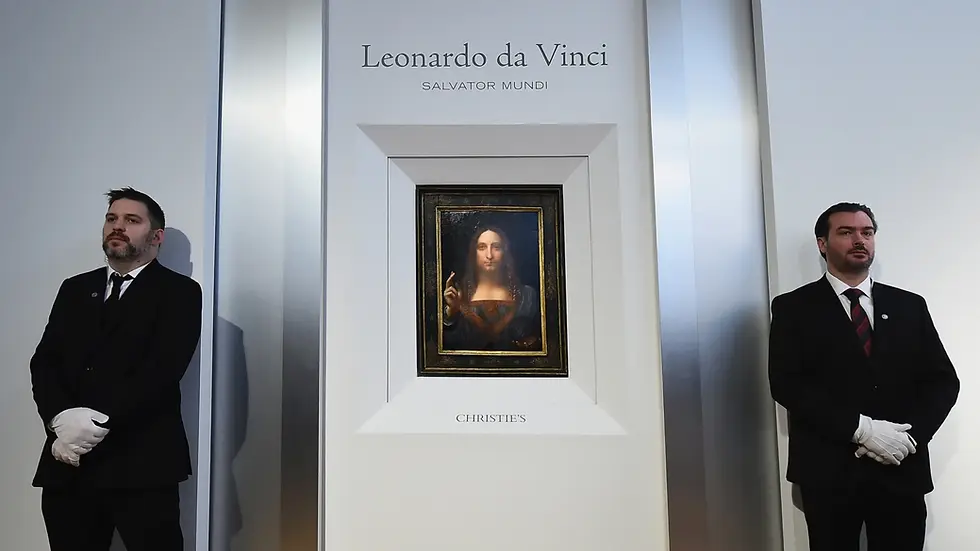
The panel did not acquire a new historical author between those dates. What changed was the judgement surrounding it, and that gap, an object unchanged, a verdict that moved by hundreds of millions of dollars, is what this Big Idea is actually about.
Judgements like that are built from several kinds of evidence, and they do not always agree. Material evidence: the panel, the pigment, the technique, examined and dated by science. Provenance: the paper trail an object leaves, or fails to leave, as it changes hands, including the four decades this panel spent missing entirely. Restoration: work that can reveal an earlier layer of paint or obscure it further, and which here removed centuries of overpaint and reconstructed damaged passages including most of Christ's face, so extensively that some critics call the 2017 picture as much restoration as original. Connoisseurship: a trained eye reading habits of hand no instrument can verify. (see our earlier lesson on this) Institutional authority: a museum's willingness to say, in public, that the first four add up to a settled attribution, which the National Gallery did in 2011 despite a genuinely split panel of specialists, two for, one against, two undecided.
This is the actual knowledge question underneath the story: how can we know who painted a five-hundred-year-old panel, when no signed contract or eyewitness account survives and every form of evidence depends on judgement rather than measurement? When the experts examining it disagree, as they did here, what justifies an institution accepting one attribution and presenting it to the public as settled fact?
What is actually at stake is more than the price. Attribution decides what kind of thing the object is allowed to be evidence of. If genuinely by Leonardo, it becomes part of a documented body of work: evidence of his late style, his workshop, his place in the Renaissance. If not, it is an anonymous, competent devotional panel, evidence of nothing beyond a generic convention. The paint is identical either way. Scholars still argue over how many surviving paintings are securely his, from as few as five or six to under twenty, which is part of why the price is not arbitrary: a claim of attribution is a claim about a rare, specific achievement. If that achievement was never real, there is nothing left to have paid for.
Big idea 2 - Social identity - George Eliot and the voice that had to change its name
The woman Mary Ann Evans became one of the greatest novelists in English by publishing as the man George Eliot. By the time she made that choice, in 1857, she was not an unknown quantity trying to break into print. She had spent years at the centre of London's literary world as the assistant editor of the Westminster Review, one of the most influential critical journals of the day, publishing essays and reviews under her own name that were read and respected. Her ambition for the novel, once she turned to it, was serious rather than modest: after finishing Middlemarch she described her novels as "simply a set of experiments in life, an endeavor to see what our thought and emotion may be capable of," and in 1856 she had already written that "art is the nearest thing to life; it is a mode of amplifying experience." She had the standing, and the ambition, to publish a novel as Mary Ann Evans. She chose not to.
Several things were probably working on that decision at once, and no single one settles it alone. A year earlier, in the same journal, she had published "Silly Novels by Lady Novelists," an essay mocking the trivial, formulaic fiction routinely produced under women's names, and she had no wish for her own first novel to be filed straight into that category before a reader had judged a sentence of it. She was also living, unmarried, with George Henry Lewes, who remained legally married to someone else, an arrangement Victorian society treated as scandalous, and a pseudonym kept that fact from attaching itself to how her books were read. A new name also let the novels be judged apart from the reputation already built around Marian Evans the critic and translator.
The puzzle is not that a woman might struggle to be published in 1857. It is that a woman who already had genuine standing and authority in literary London still calculated that her own name would count against her novels rather than for them.
This is a case of what this course has already named, under Miranda Fricker's term, testimonial injustice: a speaker's word discounted not because of what they said but because of who they are. (See Core Lesson 1) A critic reading a novel believes they are assessing the work itself, its ideas and its craft. Eliot's calculation was that the same sentences, published under a name recognisably female, were liable to be read in advance as exactly the kind of novel she had mocked a year earlier, filed before a single page was actually judged.
Linda Nochlin asked the same question about the entire discipline of art history in her 1971 essay, "Why Have There Been No Great Women Artists?" Her answer was not that women lacked the talent men had. It was that the professional apparatus of art, life-drawing academies that barred women from studying the nude, guild structures, patronage networks, family expectation, had been built for centuries around the assumption that the maker would be a man. Her own line makes the point directly: "The fault lies not in our stars, our hormones, our menstrual cycles, or our empty internal spaces, but in our institutions and our education." Nochlin explains the institution. Eliot is the lived case of a single writer working around it by disappearing behind a different name, rather than waiting for the institution itself to change.

John Berger extended the same problem from who was allowed to hold the brush to what the paintings themselves actually showed. Surveying centuries of the European nude, he argued that women were overwhelmingly cast as the object of the gaze rather than its subject: "Men act and women appear. Men look at women. Women watch themselves being looked at." The tradition Nochlin describes did not only bar women from the studio and the academy. Its actual pictures rehearsed, painting after painting, a woman learning to see herself as something looked at rather than someone who looks. Eliot's decision to write as a man did two things at once: it dodged a prejudice about who could be taken seriously as a novelist, and it let her step, at least on the page, out of a position art had spent centuries training women to occupy.
John Berger - Ways of Seeing - Women
This opening minute of Ways of Seeing's second episode states Big Idea 2's argument directly: women learn to watch themselves being looked at, carrying their own image the way men look at them. Berger extends this into art history, arguing that centuries of European painting cast women as the object of the gaze rather than its subject. Watch it alongside Nochlin's institutional argument and Eliot's choice to write as a man: three accounts of one asymmetry, one lived, one institutional, one painted.
Eliot did not wait to be disbelieved. She removed the fact that would have triggered the disbelief before a single reader opened the book. Whether that counts as a way of letting a work finally be judged on its own terms, or only as further proof of how completely identity decides the question in advance, is the same question Berger's argument leaves open: does an audience evaluate a work independently of the identity behind it, or does identity decide in advance what it is prepared to recognise as serious, truthful or valuable?
Big idea 3 - Cultural conditioning - Partch, Debussy and the ear trained to hear tune
Before reading on, listen to the clip below and register your own immediate reaction: whether it sounds harmonious, coherent and properly tuned, or whether something about it registers as strange, off, or simply wrong.
"The Drunken Concubine" Peking Opera Troupe
This extract presents a 2017–18 performance of The Drunken Concubine by the Peking Opera Troupe of the Affiliated High School of Peking University. The opera depicts the imperial consort Yang Guifei waiting for Emperor Xuanzong, who fails to arrive. She drinks alone, becoming increasingly intoxicated and emotionally exposed. The stylised singing, instrumental accompaniment, costume, gesture and movement belong to the highly codified tradition of Peking opera, in which voice and physical performance communicate character together.
That reaction is the puzzle this Big Idea is built around: whether the judgement was about the music itself, or about the training that produced the ear making it. A trained musician's sense that a passage is "in tune" feels like direct perception, the same kind of immediate judgement as feeling that a room is too warm. The three cases below test whether that feeling is direct perception at all, or something else that only feels that way.
Harry Partch, the American composer, once asked himself a simple question: why are there twelve notes in an octave? He could not find a satisfactory answer. He spent years studying the history of tuning, reading Hermann von Helmholtz's work on the physics of musical sound, and came away convinced that the modern Western system of equal-tempered tuning, the twelve fixed notes every piano and guitar is built around, "had to go." Equal temperament is itself a convention, not a fact about how music has to work: it divides the octave into twelve identical steps so that a piece can be played in any key without retuning, at the cost of every interval sitting slightly off the simple whole-number ratios the ear finds most consonant. Partch's alternative was not that older system rediscovered whole and restored intact. He built his own forty-three-note scale from just intonation, a much older tuning principle, selecting and arranging the specific frequency ratios himself. No existing instrument could play it, so he built new ones: an adapted viola, a set of bowls cut from glass carboys once used at a radiation laboratory, an instrument modelled on an ancient Greek kithara, and a marimba assembled from blocks five feet high. Partch was not an outsider looking at Western music from beyond it. He was a composer trained entirely inside that tradition, who worked out for himself that its most basic unit, the twelve-note scale, was one convention among several possible ones, not the only way music could be organised.
Claude Debussy reached a related conclusion by listening rather than calculating. At the 1889 Paris Universal Exposition he heard a Javanese gamelan ensemble for the first time, built on a five-note scale entirely unlike his own training. He wrote afterwards that gamelan music "contained all gradations, even some that we no longer know how to name, so that tonic and dominant were nothing more than empty phantoms of use to clever little children." A composer at the centre of the Western tradition heard an unfamiliar system and concluded that his own scale, not the one he was hearing, was the narrow one.
Jingju, or Peking opera, returns the same test to an audience rather than a composer. Its vocal style rests on an elaborate, explicit set of conventions built up over centuries of practice and audience expectation: fixed role types with their own registers and timbres, and precise rules governing pitch, rhythm, pronunciation and ornamentation. To an ear trained only on Western equal temperament and operatic voice production, that same singing can register as high, piercing or simply wrong, a mismatch between the performance and the trained criteria being unconsciously applied to judge it, not a failure in the singing itself. This is close to the same question Perspectives in Language asks through Sapir and Whorf: not whether a different tradition shapes what you can say, but whether it shapes what you can even perceive as coherent in the first place, before any judgement of quality gets a chance to form.
None of this makes every musical judgement equally arbitrary. Partch could give precise acoustic reasons for preferring his ratios; a Jingju audience can give equally precise reasons for judging one performer's ornamentation better than another's, entirely within their own tradition's own terms. What all three cases remove is the assumption an untrained listener makes by default: that their own ear is a neutral instrument, hearing music as it actually is rather than as a particular tradition trained it to be heard. Whether that leaves any position from which musical or artistic value could be judged as more than relative to whichever tradition trained the listener doing the judging is the question this Big Idea leaves open.
Perspective in the Arts compared
Institutions vouch for objects, societies decide whose voice counts, and cultures train what an audience can even perceive. What is left of your own judgement once you notice all three?
Mathematics answers to proof, and a demonstration either holds or it does not regardless of who is willing to assert it; Gödel's incompleteness theorem sharpens that standard rather than escaping it. Salvator Mundi shows the arts working by the opposite mechanism. The wood and paint were identical in 1958 and in 2017. What moved was not evidence a second mathematician could check, but an institution's willingness to say, in public, that the object was genuine.
History also argues over attribution, disputed authorship and forged documents, and in principle those disputes are resolvable by more evidence: a watermark, a letter, a paper trail. The National Gallery's own experts split over Salvator Mundi on the same evidence available to everyone else, and the institutional verdict prevailed regardless of that split. Where a historian's attribution dispute can in principle be closed by better evidence, this one was closed by a decision to exhibit.
The human sciences have actually measured the bias Big Idea 2 describes, rather than only narrating a single case of it. In the 1970s and 1980s, American orchestras began holding auditions behind a screen, concealing each candidate's identity from the jury. Goldin and Rouse's 2000 study of the switch found that the screen increased by 50 percent the probability a woman advanced out of preliminary rounds, and by several times her likelihood of winning the final round outright. Where Eliot hid her identity alone, unable to test what would have happened under her own name, this is the same intervention run as something closer to a controlled comparison, with a before and an after. It confirms, rather than merely illustrates, that the prejudice Big Idea 2 describes was real enough to move measurable outcomes once it was removed.
Perspectives in Language treats a related question through the Sapir-Whorf hypothesis: whether the language you speak shapes what you are able to think, and what you are able to say. Big Idea 3 asks the same question of the ear rather than the tongue. A listener raised on Western equal temperament does not choose to hear gamelan or Jingju as strange; years of unnoticed training have already shaped that perception before the listener is even aware of judging anything. Perspectives in Language asks whether your words limit your thoughts. This page asks whether your ears limit your hearing before any judgement about the music has even begun.
Natural Science sits at the far end of this page’s argument. Perspective in Natural Science tries to remove the observer’s perspective from the result entirely, through replication and peer review, even where its own Big Ideas show the attempt is not fully successful. The arts do not attempt this removal in the first place. Salvator Mundi’s value was never going to be independent of who was looking at it and which institution was willing to say so.
Think further: questions and resources
-
The National Gallery consulted five specialists before exhibiting Salvator Mundi as a genuine Leonardo. Two agreed, one disagreed, two gave no opinion, and the gallery went ahead. If an institution must sometimes act despite real disagreement among its own experts, what exactly is the exhibition label protecting: the truth about the painting, or the market that depends on a settled answer?
-
Linda Nochlin argued that the shortage of celebrated women artists reflects centuries of institutional exclusion, not a shortage of talent. If an institution that once barred a class of makers has since opened its doors, does that settle the question of whose earlier work was overlooked, or does it only open it?
-
George Eliot published under a male name to be read as making a serious, almost scientific claim about human experience. If a reader later discovers that a work hid its author's real identity, should that discovery change how the work itself is read, or only how its original reception is understood?
-
Harry Partch decided the twelve-note scale he had been trained in was an arbitrary convention, then built new instruments so he would not have to use it. If a trained musician's own sense of what sounds "in tune" turns out to be learned rather than natural, what else that feels like direct perception might also turn out to be a convention you were never told you had absorbed?
-
Big Idea 1 argues that material evidence, provenance, restoration and connoisseurship all failed to settle Salvator Mundi's attribution on their own, leaving institutional authority to decide it in practice. Core Lesson 3's Getty kouros tested the same kinds of evidence and reached no settled answer at all: fourteen months of scientific testing said one thing, expert instinct said another, and the museum eventually withdrew the statue from display rather than assert a verdict either way. Salvator Mundi's own experts were just as divided, but the National Gallery asserted a verdict anyway, and the market acted on it. What decides whether an institution facing that kind of disagreement asserts a verdict, or withdraws the object instead?
-
Return to the provocation: Banksy's canvases and Joshua Bell's playing were exactly the same object and performance whether anyone stopped to look or not, yet almost nobody recognised either as valuable on the day itself. If recognition depends this much on institutions, identity and cultural training rather than on the work in front of you, what is actually left for an audience to judge, once authority, prejudice and conditioning have already done so much of the deciding?
Films
For more see my 10 films for the TOK journey page.
🎬 WATCH — Ways of Seeing Episode 2 (1972)
John Berger directed by Mike Dibb BBC
The second episode is the direct source for Big Idea 2's own argument about the gaze, extended across the whole history of the European nude, from the Genesis story of Adam and Eve to the academic painting of the nineteenth century, arguing throughout that women were painted as the object of the gaze rather than its subject. It then does something the book cannot: it closes by showing the finished episode to five women and recording their unscripted disagreement over whether those paintings still shape how they see their own bodies today, turning an argument about looking into a live demonstration of it.
🎬 WATCH — F for Fake (1973)
F for Fake is Welles's own essay-film about the art forger Elmyr de Hory, the biographer Clifford Irving who fabricated a Howard Hughes autobiography, and Welles's own career built partly on the theatrical hoax of the 1938 War of the Worlds broadcast. The film never settles whether any of its subjects, including Welles himself, is a genuine artist or an elaborate confidence trick, which is exactly Big Idea 1's own question about who gets to decide.
🎬 WATCH — Music Studio (1958)
Madeline Tourtelot
This seventeen-minute documentary follows Partch through his cramped Chicago studio, showing the actual instruments described in Big Idea 3: cloudchamber bowls cut from laboratory glassware, the 72-stringed Kithara built on an ancient Greek model, the Diamond Marimba, and the Chromolodeon, adapted from a reed organ to play Partch's own scale. Partch narrates the tour himself, describing the results as "unusual in size, shape and philosophic purpose" rather than mere inventions. Seeing the scale and strangeness of the actual objects makes Big Idea 3's claim, that equal temperament was only ever one convention among others, considerably harder to dismiss than reading about it.
🎬 WATCH — Genghis Blues (1999)
This documentary follows Paul Pena, a blind American blues musician, as he teaches himself Tuvan throat singing, a vocal tradition built on overtones and tunings with no equivalent in Western music, purely from a shortwave radio broadcast, and eventually travels to Tuva to compete in a national throatsinging competition. The film is a direct, real-world case of Big Idea 3: a trained Western musician's ear meeting an unfamiliar tonal system and learning, slowly, to hear it as coherent rather than strange. My students can watch the whole film here.
Further reading
📚 READ - The Rest Is Noise, Alex Ross (2007)
Read the Harry Partch section of "Beethoven Was Wrong" (pp. 522-524) for the twelve-notes story in full, and the account of Debussy at the 1889 Paris Exposition in "Doctor Faust" (pp. 44-45) for the gamelan encounter behind Big Idea 3. Both passages are the direct source for the claims made on this page. In the library in TOK Books > Arts.
📚 READ - Proust Was a Neuroscientist, Jonah Lehrer (2007)
Read Chapter 2, "George Eliot: The Biology of Freedom" (pp. 24-26), for the fuller case behind Big Idea 2, including the "simply a set of experiments in life" letter quoted on this page and Eliot's argument, against her critic Henry James, that a novel could be a scientific instrument rather than an escape from one. In the library in TOK Books > General TOK books.
📚 READ - "Why Have There Been No Great Women Artists?", Linda Nochlin (1971)
Read the full essay for Nochlin's argument that the absence of celebrated women artists is an institutional fact, not a talent gap, built out of centuries of exclusion from academies, guilds and the study of the nude. The 2021 fiftieth-anniversary edition, with Catherine Grant, adds a retrospective introduction assessing what has and has not changed since 1971. Both in the library in TOK Books > Arts.
📚 READ - The Transfiguration of the Commonplace, Arthur Danto (1981)
Read the discussion of Han van Meegeren's Vermeer forgeries and the Picasso necktie thought experiment that precedes it (pp. 50-51) for Danto's argument that being a forgery is not a visible property of an object but a fact about its history, the circumstances of its making, not what it looks like sitting in front of you. It gives Big Idea 1's Salvator Mundi case its sharpest possible statement: two physically similar objects can differ completely in status for reasons that were never available to the eye alone. In the library in TOK Books > Arts.
📚 READ - Art and Illusion, E. H. Gombrich (1960; 2000 preface)
Read the "Preface to the 2000 Edition" ("Images and Signs," pp. xxv-xxviii), where Gombrich answers the argument that images are pure convention using Shakespeare's Prologue to Henry V and the example of a puppet show: an audience knows the puppets are tiny and wooden, yet stops seeing them that way, a shift he calls a "mental set" rather than a fixed agreement. It extends Big Idea 3's claim about the ear to the eye: what looks like direct, untrained perception in a painting depends on a built, breakable expectation, not a convention agreed in advance the way a word's meaning is. In the library in TOK Books > Arts.