

areas of knowledge - Maths
Scope of Maths
What is essential is invisible to the eye
Sixty years early
THE PROVOCATION

In the 1850s, the German mathematician Bernhard Riemann developed a new kind of geometry. Euclidean geometry - the geometry of flat surfaces, parallel lines that never meet, angles in a triangle that sum to 180 degrees - had been the only geometry for two thousand years. Riemann showed that consistent geometries were possible on curved surfaces, where none of these rules applied. It was a piece of pure mathematics, pursued because Riemann found it interesting. There was no application in view. Contemporary mathematicians described it as pointless, extraordinarily abstract, even for mathematics.
Sixty years later, Albert Einstein used Riemann's curved geometry to build the general theory of relativity - the best description of gravity that physics has. Without Riemannian geometry, general relativity cannot be written down. Einstein did not go looking for a geometry that would fit his physics. The geometry already existed, sitting unused, waiting.
This is not an isolated case. Complex numbers - invented in the sixteenth century to handle equations whose solutions seemed imaginary - turned out to be necessary for quantum mechanics. The mathematics of wave functions, which describes the behaviour of particles at the smallest scale, cannot be expressed without them. The Dirac equation, which predicted the existence of antimatter, was derived from mathematical elegance before anyone had looked for antimatter experimentally.
In 1921, Einstein asked: "How is it possible that mathematics, a product of human thought that is independent of experience, fits so excellently the objects of physical reality?" The physicist Eugene Wigner gave the puzzle a name in 1960 - "the unreasonable effectiveness of mathematics in the natural sciences" - and acknowledged that no one had a satisfying answer.
The puzzle is worth thinking about. Mathematics is the only AOK that does not, in principle, require a material world. A historian without traces cannot do history. A natural scientist without observations cannot do science. A mathematician without physical reality can still do mathematics - the discipline runs on axioms and logical inference alone, in a space that exists independently of whether there is anything outside the mind. And yet it keeps describing what is outside the mind with a precision no other AOK approaches.
The scope question for mathematics is not simply what mathematics covers. It is what kind of knowledge mathematics is, and why an AOK that requires no world turns out to be the best language the world has.
Big idea 1 - The knowledge that requires no world.
If you have worked through a mathematical proof, you already know something that takes philosophers considerable effort to articulate. At some point the chain of logical steps closes, and you see that the conclusion must be true - not probably true, not true for the cases you have checked, but necessarily true. No further examples will strengthen what you know. No counterexample can exist. The proof is complete. This is a different kind of certainty from anything available in history, natural science, or the arts, and it does not come from looking at the world.
Every other AOK has a dependency it cannot escape. History requires traces - documents, objects, ruins - without which there is nothing to work on. Natural science requires observations: the hypothesis must eventually meet the world. Human sciences require people, their behaviour, their institutions. The arts require experience, the capacity to perceive and respond to what is made. Each of these AOKs is tethered to something outside the mind.
Mathematics is different. The working material of mathematics is axioms and logical inference - structures that can be constructed entirely in thought, with no reference to anything external. You do not need to look at the world to know that the interior angles of a Euclidean triangle sum to 180 degrees, or that there is no largest prime number. The proofs do not require experiments. They require only that each step follow from the last.
Bertrand Russell, in The Problems of Philosophy (1912), gives a clean example of what this means in practice. We know nothing about who will be living in London a hundred years from now - their names, their number, their circumstances. But we know something about them with certainty: "any two of them and any other two of them will make four of them." This is what Russell calls a priori knowledge - knowledge that is logically independent of experience. We can state it about people who do not yet exist, in circumstances no one can predict, with complete confidence. No other AOK produces knowledge of this kind.
This independence from the world is what makes the scope of mathematics genuinely distinctive. A historian's claim about the past depends on evidence from the past. A biologist's claim about a species depends on observations of that species. A mathematical claim depends on nothing outside mathematics itself - and this means it holds everywhere experience might take us, including places experience has never gone.

Big idea 2 - The mathematics came first.
If you have studied complex numbers in your mathematics class, you have already handled one of the stranger exhibits in this story. The number i - the square root of -1 - was called "imaginary" when it was introduced in the sixteenth century because it seemed to correspond to nothing in physical reality. There is no length, no quantity, no measurement that gives you -1 when squared. For two centuries mathematicians used complex numbers as a calculational convenience while largely agreeing they were a fiction. Then quantum mechanics was developed in the 1920s, and it turned out that the wave functions describing how particles actually behave at the smallest scale cannot be written without complex numbers. The mathematics is not merely convenient here - it is structurally necessary. The "imaginary" number is part of the fabric of physical reality.
Imaginary Numbers Are Real
Imaginary numbers seem strange because they solve equations that have no answer on the ordinary number line. The equation x² + 1 = 0 has no real roots, yet Gauss’s Fundamental Theorem of Algebra says a quadratic should have two. The problem is not the equation but our limited idea of number. Just as fractions, zero and negatives were once resisted, imaginary numbers extend mathematics into a new dimension, revealing solutions we could not previously see.
The examples accumulate to a pattern that is difficult to explain away. Greek mathematicians, working two millennia before Newton, classified the curves produced by slicing a cone at different angles - ellipses, parabolas, hyperbolas - as a problem in pure geometry with no physical application in view. Kepler and Newton later found that bodies moving under gravity follow precisely these curves. Riemann's geometry of curved surfaces, developed in the 1850s as pure mathematics, became the language of general relativity sixty years later. When Hardy wrote in 1940 that "no one foresaw the applications of matrices and groups and other purely mathematical theories to modern physics," he intended it as evidence that pure mathematics was safely useless. It reads now as a description of the pattern he failed to notice.
The case of Paul Dirac makes the point most sharply. Dirac was not searching experimentally for a new particle when he wrote down his equation for the electron in 1928. He was pursuing mathematical beauty - the symmetry and elegance of the underlying algebra. The equation had two symmetrical parts: one describing a negatively charged particle, and one describing a similar particle with a positive charge. No such particle was known to exist. The mathematics implied it should. The positron - antimatter - was confirmed experimentally four years later. As Dirac himself put it in 1963: "I think there is a moral to this story, namely that it is more important to have beauty in one's equations than to have them fit experiment."
The puzzle Wigner named in 1960 - "the unreasonable effectiveness of mathematics in the natural sciences" - is not simply that mathematics is useful. It is that mathematicians working in total abstraction, guided by criteria of internal beauty and logical coherence rather than by physical observation, keep producing structures that the physical world turns out to conform to.
One response, developed by the neuroscientist Stanislas Dehaene, is that the puzzle dissolves under closer inspection. Mathematicians produce a vast overabundance of pure mathematics. Physicists select from this overabundance the structures that fit their observations - a process Dehaene compares to Darwinian selection. On this account, the fit between mathematics and physics is less miraculous than it appears: we notice the matches and forget the enormous volume of pure mathematics that never finds physical application.
This response has some force. But it does not fully account for cases like Dirac's, where the mathematics did not merely match an already-known phenomenon but predicted a new one. The equation preceded the discovery. The mathematics came first, and the physical reality followed.
Big idea 3 - Maths is justified as art
If you have studied complex numbers in your mathematics class, you have already handled one of the stranger exhibits in this story. The number i - the square root of -1 - was called "imaginary" when it was introduced in the sixteenth century because it seemed to correspond to nothing in physical reality. There is no length, no quantity, no measurement that gives you -1 when squared. For two centuries mathematicians used complex numbers as a calculational convenience while largely agreeing they were a fiction. Then quantum mechanics was developed in the 1920s, and it turned out that the wave functions describing how particles actually behave at the smallest scale cannot be written without complex numbers. The mathematics is not merely convenient here - it is structurally necessary. The "imaginary" number is part of the fabric of physical reality.
Mathematics is the only AOK with a significant internal division between its pure and applied forms - two communities, often in separate university departments, with different aims, different criteria for what counts as good work, and sometimes mutual disdain. No equivalent distinction exists in history or the natural sciences. We do not ask whether a historian's account of the French Revolution is pure or applied history. In mathematics, the question is live and contested.
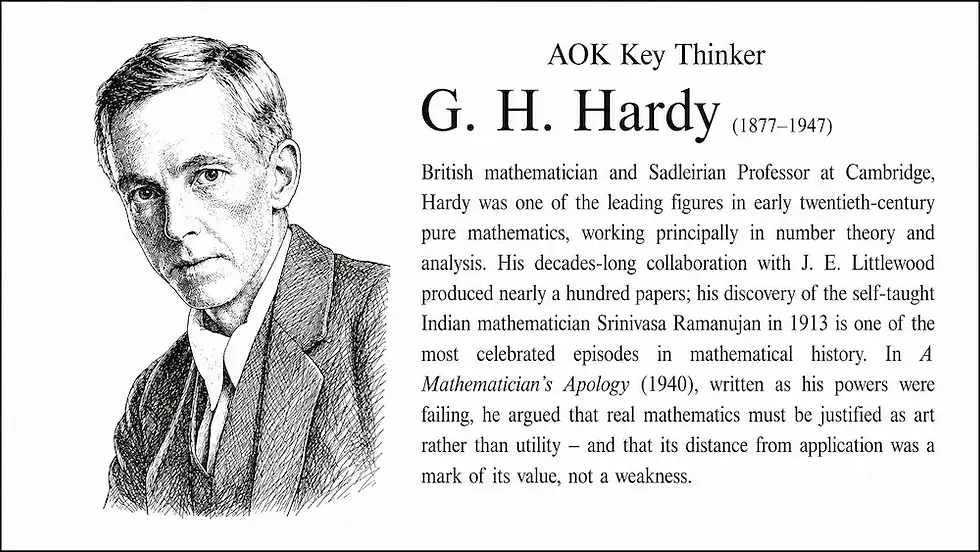
G. H. Hardy made the most sustained case for pure mathematics in A Mathematician's Apology (1940). His argument was straightforward: real mathematics - the serious, beautiful kind that occupies the best mathematical minds - has no practical application, and this is beside the point. "A mathematician, like a painter or a poet, is a maker of patterns. If his patterns are more permanent than theirs, it is because they are made with ideas." The criterion for good mathematics is not utility but beauty. As Hardy put it: "Beauty is the first test: there is no permanent place in the world for ugly mathematics."
For Hardy, the division between pure and applied mathematics was also a division in value. "Trivial" mathematics - the kind that engineers and physicists actually use - could be justified on practical grounds. Real mathematics required a different justification entirely: "there is no such defence for the real mathematics, which must be justified as art if it can be justified at all."
The history of the twentieth century complicated this position considerably. Hardy wrote in 1940 that real mathematics had no effects on war and that number theory in particular was supremely useless. Within thirty years of his death, the theory of numbers became the mathematical foundation of modern cryptography. The RSA algorithm - which secures every encrypted digital communication, including military ones - rests on the difficulty of factoring large prime numbers, exactly the kind of pure arithmetic Hardy valued for its distance from application. He was not wrong that he was doing pure mathematics. He was wrong that pure mathematics stays pure.
The Hardy irony does not settle the question, however. It could be read as evidence that the pure/applied distinction is ultimately unstable - that enough time and enough physicists will find a use for almost anything. But it could equally be read as further evidence of the Wigner puzzle from Big Idea 2: pure mathematics, pursued for reasons of beauty and internal coherence with no application in view, keeps turning out to describe or underpin the world.
The philosopher of mathematics Reuben Hersh offered a different challenge to Hardy's picture. For Hersh, the whole framing of pure versus applied, abstract versus physical, misses what mathematics actually is: "neither physical nor mental, it's social. It's part of culture, it's part of history. It's like law, like religion, like money, like all those other things which are very real, but only as part of collective human consciousness." On this account, the pure/applied distinction is not a distinction between two kinds of mathematical truth - it is a distinction between two communities of human practice. The question of whether mathematics exists independently of human minds, or is made by them, belongs to the next page.
Curriculum note: The Mathematical Exploration - the internal assessment running across most of your DP course - asks you to choose a topic and investigate it mathematically. Some students choose topics with direct real-world application; others choose problems that interest them for purely mathematical reasons. That choice enacts the distinction Hardy was writing about. Neither is more legitimate than the other, which is itself part of the argument.
The scope of Maths compared
A knowledge that requires no world
The three big ideas on this page describe an AOK unlike any other in the framework. Mathematics requires no material world to function - its claims are established by proof rather than evidence, and a proven theorem cannot be overturned by new observation. It is pursued, at its purest, for reasons of beauty and internal coherence rather than utility. And yet it keeps turning out to underpin, describe, and predict the physical world with a precision no other AOK approaches. Placing Mathematics alongside the other AOKs sharpens what is strange about it.
The most immediate comparison is with Natural Science. Both disciplines value rigour and precision, and both produce claims that aspire to be universally true. But natural science is empirical - its theories must be tested against observation, and no scientific claim is ever finally proven, only provisionally confirmed or refuted. Mathematics is a priori - its claims are established by proof alone. No observation could refute the Pythagorean theorem. The relationship between the two AOKs is also asymmetric: natural science uses mathematics as its primary language, but mathematics does not depend on natural science at all. The traffic between them runs one way.
The comparison with History is the sharpest contrast in the framework. Historical knowledge is knower-dependent by definition: Historians each argue from different angles that who is doing the knowing shapes what gets known. Mathematical knowledge appears to be knower-independent. The Pythagorean theorem was true before Pythagoras, holds regardless of who proves it, and carries no trace of the mathematician's nationality, era, or political situation. Where History is the AOK most saturated by time, contingency, and human perspective, Mathematics is the AOK most independent of all three.
The comparison with The Arts is less obvious but worth making - Hardy made it himself. The mathematician is a maker of patterns, beauty is a genuine criterion for mathematical work, and pure mathematics is pursued for its own sake rather than for external use. The key difference is necessity. A poem could have been written differently and still been a good poem. An elegant proof could not have been otherwise - the conclusion was forced, the path was the only available one. Mathematical beauty has a component of inevitability that aesthetic beauty does not require.
Human Science sits at the opposite end from Mathematics on the same question. Scope of Human Science argues that the knower and the known are made of the same material, so a psychologist’s own position is always part of what gets studied. A proof does not have a position. Whoever checks a piece of mathematics checks the same argument, which is exactly what Human Science, on its own terms, can never fully claim about itself.
Next: Perspectives in Maths
Think further: questions and resources
-
Russell argues that we can know mathematical truths about the future inhabitants of London without knowing anything about them. If mathematical knowledge is truly independent of experience, what role does the mathematician actually play? Are proofs discoveries or constructions?
-
Einstein asked why mathematics, produced by human minds independent of experience, fits physical reality so well. Dehaene suggests this is less mysterious than it appears - mathematicians overproduce and physicists select what fits. Does Dehaene's response dissolve the puzzle, or merely restate it at a different level?
-
Dirac claimed it is more important to have beauty in one's equations than to have them fit experiment. Is aesthetic judgment a reliable guide to mathematical truth - or does the Dirac case only seem compelling because his equation turned out to be correct?
-
Hardy argued that real mathematics must be justified as art if it can be justified at all. Number theory, which he considered the most beautiful and most useless branch of mathematics, became the foundation of modern cryptography within thirty years of his death. Does this refute his argument, or is it irrelevant to it?
-
Hersh argues that mathematics is "social, like law, like religion, like money." If mathematics is a social construction, could a different society have arrived at different mathematics - including a different arithmetic? Or are some mathematical truths so fundamental that no human society could have constructed them otherwise?
-
The History scope page argues that historical knowledge is knower-dependent - who is doing the knowing shapes what gets known. Mathematics appears to be the opposite: the Pythagorean theorem holds regardless of who proves it. Is knower-independence the defining feature of mathematical knowledge, or is it an illusion that disappears when you look at which problems mathematicians choose to work on?
Films
For more see my 10 films for the TOK journey page.
🎬 WATCH — The Man Who Knew Infinity (2015)
Matt Brown.
Dev Patel plays Srinivasa Ramanujan, a self-taught mathematician from Madras who arrives at Cambridge in 1914 with notebooks full of results he cannot prove. Jeremy Irons plays Hardy, who recognises the genius immediately but insists on proof as the only acceptable standard. The central tension of the film is the tension at the heart of Big Idea 1: what counts as mathematical knowledge, and is proof the only route to it? Ramanujan claimed his results came from a goddess. Hardy believed mathematics required rigorous demonstration. Both were right about something the other couldn't see. The film is also the best portrait of Hardy available - and of why he thought mathematics was closer to art than science. My students can watch the film here.
🎬 WATCH — Fermat's Last Theorem (1996)
In 1637, Pierre de Fermat scribbled a claim in the margin of a book and noted that the proof was too large to fit there. The proof was never found. For 350 years, Fermat's Last Theorem remained the most famous unsolved problem in mathematics - simple enough to state, apparently impossible to prove. This documentary follows Andrew Wiles, who spent seven years working on it in secret, announced a proof in 1993, watched it collapse under scrutiny, and then found the fix. The film earns its place on this page because of what it shows about proof from the inside: the isolation, the false dawn, and the specific quality of certainty that comes when a mathematical argument finally closes. You can watch the full film in English here.
Further reading
📚 READ - A Mathematician's Apology by G. H. Hardy (1940)
Read the whole thing. It is 90 pages of main text and can be finished in an afternoon. Hardy's argument for pure mathematics as art is the spine of Big Idea 3, but the book also touches everything else on this page: what makes a mathematical theorem serious, why beauty matters, the relationship between mathematics and the physical world. The foreword by C. P. Snow, which runs to about 50 pages, is almost as good as the book itself - a portrait of Hardy as a person that makes the argument feel lived rather than theoretical. In the library in TOK Books > Maths.
📚 READ - The Problems of Philosophy by Bertrand Russell (1912)
Chapters 7 and 8 are what you need: "On Our Knowledge of General Principles" and "How A Priori Knowledge is Possible." Russell is writing for a general audience and both chapters are clear and short. The London inhabitants example from Big Idea 1 is in Chapter 8. The rest of the book is worth your time - Russell covers perception, matter, and the nature of knowledge in under 100 pages - but Chapters 7 and 8 connect directly to this page. In the library in TOK Books > General TOK books.
📚 READ - Mathematics: A Very Short Introduction by Timothy Gowers (2002)
Gowers is a Fields Medal winner writing for non-mathematicians. Chapter 1 addresses the scope questions directly: what is mathematics, what makes mathematical knowledge distinctive, and how abstract structures relate to the physical world. The book is under 150 pages and covers far more ground than this page requires - dip into it rather than reading it straight through. In the library in TOK Books > Maths.
📚 READ - Fermat's Last Theorem by Simon Singh (1997)
The book behind the documentary. Singh tells the full story of Wiles and Fermat's theorem with more space for the mathematics and its history than the film allows. Chapter 1, which covers the history of the problem from ancient Greece to the twentieth century, is the most relevant to this page - it shows pure mathematics accumulating across millennia with no application in view. The rest of the book is a gripping account of what mathematical proof actually demands. In the library in TOK Books > Maths.